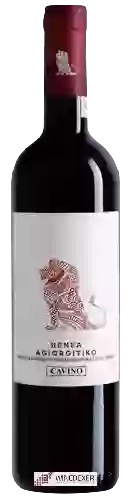
The Winery Cavino of Attiki of Continental Greece

The Winery Cavino is one of the largest wineries in the world. It offers 75 wines for sale in of Attiki to come and discover on site or to buy online.
Looking for the best Winery Cavino wines in Attiki among all the wines in the region? Check out our tops of the best red, white or effervescent Winery Cavino wines. Also find some food and wine pairings that may be suitable with the wines from this area. Learn more about the region and the Winery Cavino wines with technical and enological descriptions.
How Winery Cavino wines pair with each other generally quite well with dishes of beef, lamb or veal such as recipes of beef tagliata with truffle oil, leg of lamb in a casserole or osso bucco.
On the nose the red wine of Winery Cavino. often reveals types of flavors of cherry, oaky or blackberry and sometimes also flavors of red fruit, vanilla or plum. In the mouth the red wine of Winery Cavino. is a powerful with a nice balance between acidity and tannins.
The wine region of Attiki is located in the region of Continental Greece of Greece. Wineries and vineyards like the Domaine Costa Lazaridi or the Domaine Costa Lazaridi produce mainly wines white, red and pink. The most planted grape varieties in the region of Attiki are Savatiano, Agiorgitiko and Cabernet-Sauvignon, they are then used in wines in blends or as a single variety. On the nose of Attiki often reveals types of flavors of pineapple, straw or oaky and sometimes also flavors of smoke, earthy or ginger.
In the mouth of Attiki is a powerful with a nice freshness. We currently count 43 estates and châteaux in the of Attiki, producing 127 different wines in conventional, organic and biodynamic agriculture. The wines of Attiki go well with generally quite well with dishes of beef, lamb or spicy food.
How Winery Cavino wines pair with each other generally quite well with dishes of beef, lamb or spicy food such as recipes of beef tournedos with boursin, lamb fillet with monbazillac or chicken tagine.
On the nose the pink wine of Winery Cavino. often reveals types of flavors of red fruit.
How Winery Cavino wines pair with each other generally quite well with dishes of pork, rich fish (salmon, tuna etc) or spicy food such as recipes of oven-baked sausage, salmon steaks with cream sauce or hake fillet with curry.
On the nose the white wine of Winery Cavino. often reveals types of flavors of earth, microbio or vegetal and sometimes also flavors of oak, tree fruit or spices.
Chemical stimulation that tightens the mucous membranes of the mouth and causes a sensation of harshness, which is characteristic of the presence of tannins. With time, the tannins lose their harshness and become softer.
How Winery Cavino wines pair with each other generally quite well with dishes of spicy food or sweet desserts such as recipes of garlic shrimp or chocolate mug cake.
On the nose the sweet wine of Winery Cavino. often reveals types of flavors of non oak, earth or microbio and sometimes also flavors of oak, spices or red fruit.
How Winery Cavino wines pair with each other generally quite well with dishes of beef, lamb or spicy food such as recipes of baked marrow bones, lamb kebab or shrimp with curry express.
On the nose the sparkling wine of Winery Cavino. often reveals types of flavors of red fruit, tree fruit.
In Burgundy, the fourth and final level of classification (above the regional, communal and premier cru appellations), designating the wines produced on delimited plots of land (the climats) whose name alone constitutes the appellation. The climats classified as Grand Cru are 32 in the Côte d'Or plus one in Chablis which is divided into 7 distinct climats. Representing barely 1.5% of the production, the Grand Crus are the aristocracy of Burgundy wines.
Planning a wine route in the of Attiki? Here are the wineries to visit and the winemakers to meet during your trip in search of wines similar to Winery Cavino.
White muscat is a white grape variety of Greek origin. Present in several Mediterranean vineyards, it has several synonyms such as muscat de Die, muscat blanc and frontignac. In France, it occupies a little less than 7,000 ha out of a total of 45,000 ha worldwide. Its young shoots are downy. Its youngest leaves are shiny, bronzed and scabrous. The berries and bunches of this variety are all medium-sized. The flesh of the berries is juicy, sweet and firm. Muscat à petits grains has a second ripening period and buds early in the year. It is moderately vigorous and must be pruned short. It likes poor, stony slopes. This variety is often exposed to spring frosts. It fears mildew, wasps, grape worms, court-noué, grey rot and powdery mildew. Muscat à petits grains is used to make rosé wines and dry white wines. Orange, brown sugar, barley sugar and raisins are the known aromas of these wines.