The Château Sainte Croix of Provence
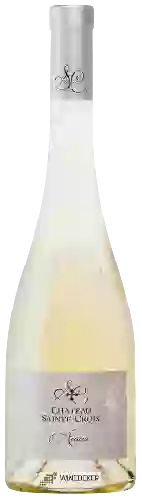
Château Sainte Croix
The winery offers 35 different wines
3.7


Note - 1Note - 1Note - 1Note - 0.5Note - 0
Its wines get an average rating of 3.7.
It is ranked in the top 386 of the estates of Provence.
It is located in Provence

The Château Sainte Croix is one of the best wineries to follow in Provence.. It offers 35 wines for sale in of Provence to come and discover on site or to buy online.
Top Château Sainte Croix wines

Looking for the best Château Sainte Croix wines in Provence among all the wines in the region? Check out our tops of the best red, white or effervescent Château Sainte Croix wines. Also find some food and wine pairings that may be suitable with the wines from this area. Learn more about the region and the Château Sainte Croix wines with technical and enological descriptions.

The top white wines of Château Sainte Croix

Food and wine pairings with a white wine of Château Sainte Croix

How Château Sainte Croix wines pair with each other generally quite well with dishes of rich fish (salmon, tuna etc), shellfish or sweet desserts such as recipes of risotto with fresh salmon and zucchini, creamy tomato squid or tarte tatin.

The best vintages in the white wines of Château Sainte Croix

  • 2016With an average score of 3.71/5
  • 2012With an average score of 3.70/5
  • 2014With an average score of 3.40/5
  • 2018With an average score of 3.00/5

The grape varieties most used in the white wines of Château Sainte Croix.

  • Sémillon
  • Chardonnay
  • Cabernet Franc

Discovering the wine region of Provence

Provence is a wine region in the far southeast of France, best known for the quality (and quantity) of its rosé wines and for its Warm, mild Climate. The modernization that is taking place in many of the traditional wine regions of southern France has not yet taken place to the same extent in Provence, but there are Clear signs of change. The region's Grape varieties, in particular, have come under scrutiny in recent decades. Traditional varieties such as Carignan, Barbaroux (Barbarossa from Sardinia) and Calitor are being replaced by more commercially viable varieties such as Grenache, Syrah and even Cabernet Sauvignon.

The term "Varietal improvers" is gaining ground in Provence, as it is in the neighbouring Languedoc-Roussillon. The most successful local varieties, Mourvèdre, Tibouren and Vermentino (known locally as Rolle), have remained in favor, proving their value in Provence wines, in red, rosé and white respectively. The Vineyards of Provence cover an area of France's southeastern coastline that measures about 200 kilometers from east to west. In this definitely Mediterranean climate - no Provencal vineyard is more than 55 km from the Mediterranean - the vines enjoy about 3,000 hours of sunshine a year, as well as an average annual temperature of 14.

5°C.

The top sparkling wines of Château Sainte Croix

Food and wine pairings with a sparkling wine of Château Sainte Croix

How Château Sainte Croix wines pair with each other generally quite well with dishes of spicy food or sweet desserts such as recipes of pho soup or express cherry clafoutis.

The grape varieties most used in the sparkling wines of Château Sainte Croix.

  • Muscat Blanc

Discover the grape variety: Sémillon

Sémillon blanc is a grape variety that originated in France (Bordeaux). It produces a variety of grape specially used for wine making. It is rare to find this grape to eat on our tables. Note that this grape variety can also be used for the elaboration of eaux de vie. This variety of vine is characterized by large bunches of grapes, and grapes of large size. Sémillon Blanc can be found in several vineyards: South-West, Languedoc & Roussillon, Cognac, Bordeaux, Armagnac, Provence & Corsica, Loire Valley, Rhone Valley, Savoie & Bugey, Beaujolais.

The top pink wines of Château Sainte Croix

Food and wine pairings with a pink wine of Château Sainte Croix

How Château Sainte Croix wines pair with each other generally quite well with dishes of pork, shellfish or vegetarian such as recipes of wild boar stew, mussels with white wine and tomato or light tuna-tomato quiche (without cream).

Organoleptic analysis of pink wines of Château Sainte Croix

On the nose the pink wine of Château Sainte Croix. often reveals types of flavors of citrus, peach or strawberries and sometimes also flavors of apricot, lemon or melon. In the mouth the pink wine of Château Sainte Croix. is a with a nice freshness.

The best vintages in the pink wines of Château Sainte Croix

  • 2020With an average score of 4.20/5
  • 0With an average score of 4.00/5
  • 2016With an average score of 3.93/5
  • 2013With an average score of 3.85/5
  • 2019With an average score of 3.78/5
  • 2015With an average score of 3.76/5

The grape varieties most used in the pink wines of Château Sainte Croix.

  • Grenache
  • Shiraz/Syrah
  • Cinsault
  • Cabernet Sauvignon
  • Cabernet Franc
  • Malbec

The word of the wine: Viscosity

Consistency of wine reminiscent of the tactile sensation of sugar syrup with varying degrees of fluidity, due to the alcohol and natural sugar in the grapes present in sweet wines. In excess, this sensation can make the wine pasty and heavy. To the eye, viscosity is referred to as tears.

The top red wines of Château Sainte Croix

Food and wine pairings with a red wine of Château Sainte Croix

How Château Sainte Croix wines pair with each other generally quite well with dishes of pasta, veal or pork such as recipes of pasta with ham, lamb confit with new potatoes or tomatoes stuffed with sausage meat.

Organoleptic analysis of red wines of Château Sainte Croix

On the nose the red wine of Château Sainte Croix. often reveals types of flavors of red fruit. In the mouth the red wine of Château Sainte Croix. is a powerful with a nice balance between acidity and tannins.

The best vintages in the red wines of Château Sainte Croix

  • 2012With an average score of 4.00/5
  • 2010With an average score of 4.00/5
  • 2016With an average score of 3.93/5
  • 2014With an average score of 3.83/5
  • 2015With an average score of 3.71/5
  • 2017With an average score of 3.66/5

The grape varieties most used in the red wines of Château Sainte Croix.

  • Shiraz/Syrah
  • Grenache
  • Mourvedre
  • Gamay
  • Cinsaut
  • Carignan

Discover the grape variety: Cinsault

Cinsaut noir is a grape variety that originated in France (Provence). It produces a variety of grape specially used for wine making. It is rare to find this grape to eat on our tables. This variety of grape is characterized by large bunches and large grapes. Cinsaut noir can be found in several vineyards: South-West, Cognac, Bordeaux, Provence & Corsica, Rhône valley, Languedoc & Roussillon, Loire valley, Savoie & Bugey, Beaujolais, Armagnac.

The top sweet wines of Château Sainte Croix

Food and wine pairings with a sweet wine of Château Sainte Croix

How Château Sainte Croix wines pair with each other generally quite well with dishes of spicy food or sweet desserts such as recipes of currywurst or simple pancake batter.

The grape varieties most used in the sweet wines of Château Sainte Croix.

  • Muscat Blanc

The word of the wine: Tries (harvest by)

Harvesting in several successive passages to harvest at their optimal concentration the grapes affected by noble rot. They allow the production of great sweet wines.

Discover other wineries and winemakers neighboring the Château Sainte Croix

Planning a wine route in the of Provence? Here are the wineries to visit and the winemakers to meet during your trip in search of wines similar to Château Sainte Croix.

Discover the grape variety: Cabernet franc

Cabernet Franc is one of the oldest red grape varieties in Bordeaux. The Libourne region is its terroir where it develops best. The terroirs of Saint-Emilion and Fronsac allow it to mature and develop its best range of aromas. It is also the majority in many blends. The very famous Château Cheval Blanc, for example, uses 60% Cabernet Franc. The wines produced with Cabernet Franc are medium in colour with fine tannins and subtle aromas of small red fruits and spices. When blended with Merlot and Cabernet Sauvignon, it brings complexity and a bouquet of aromas to the wine. It produces fruity wines that can be drunk quite quickly, but whose great vintages can be kept for a long time. It is an earlier grape variety than Cabernet Sauvignon, which means that it is planted as far north as the Loire Valley. In Anjou, it is also used to make sweet rosé wines. Cabernet Franc is now used in some twenty countries in Europe and throughout the world.