The Winery Chapelle Paul Blanc of Costières-de-Nîmes of Rhone Valley
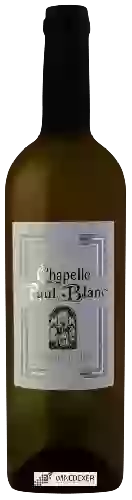
Winery Chapelle Paul Blanc
The winery offers 2 different wines
3.7


Note - 1Note - 1Note - 1Note - 0.5Note - 0
Its wines get an average rating of 3.7.
It is ranked in the top 108 of the estates of Rhone Valley.
It is located in Costières-de-Nîmes in the region of Rhone Valley

The Winery Chapelle Paul Blanc is one of the best wineries to follow in Costières-de-Nîmes.. It offers 2 wines for sale in of Costières-de-Nîmes to come and discover on site or to buy online.
Top Winery Chapelle Paul Blanc wines

Looking for the best Winery Chapelle Paul Blanc wines in Costières-de-Nîmes among all the wines in the region? Check out our tops of the best red, white or effervescent Winery Chapelle Paul Blanc wines. Also find some food and wine pairings that may be suitable with the wines from this area. Learn more about the region and the Winery Chapelle Paul Blanc wines with technical and enological descriptions.

The top white wines of Winery Chapelle Paul Blanc

Food and wine pairings with a white wine of Winery Chapelle Paul Blanc

How Winery Chapelle Paul Blanc wines pair with each other generally quite well with dishes of pork, game (deer, venison) or shellfish such as recipes of steamed pork chops, giant paella cooked on a wood fire or stuffed squid in the sétoise sauce.

The grape varieties most used in the white wines of Winery Chapelle Paul Blanc.

  • Viognier
  • Roussanne
  • Marsanne

Discovering the wine region of Costières-de-Nîmes

The wine region of Costières-de-Nîmes is located in the region of Rhône méridional of Rhone Valley of France. Wineries and vineyards like the Domaine Scamandre or the Château d'Or et de Gueules produce mainly wines red, pink and white. The most planted grape varieties in the region of Costières-de-Nîmes are Mourvèdre, Roussanne and Viognier, they are then used in wines in blends or as a single variety. On the nose of Costières-de-Nîmes often reveals types of flavors of non oak, thyme or raisin and sometimes also flavors of clove, cocoa or coffee.

In the mouth of Costières-de-Nîmes is a powerful with a nice freshness. We currently count 316 estates and châteaux in the of Costières-de-Nîmes, producing 875 different wines in conventional, organic and biodynamic agriculture. The wines of Costières-de-Nîmes go well with generally quite well with dishes of beef, lamb or game (deer, venison).

The top red wines of Winery Chapelle Paul Blanc

Food and wine pairings with a red wine of Winery Chapelle Paul Blanc

How Winery Chapelle Paul Blanc wines pair with each other generally quite well with dishes of beef, lamb or game (deer, venison) such as recipes of pastasciutta (corsica), caramelized lamb mice or roast pheasant.

Organoleptic analysis of red wines of Winery Chapelle Paul Blanc

On the nose the red wine of Winery Chapelle Paul Blanc. often reveals types of flavors of tropical, citrus or minerality and sometimes also flavors of stone, stone fruit or earth.

The best vintages in the red wines of Winery Chapelle Paul Blanc

  • 2015With an average score of 3.70/5

The grape varieties most used in the red wines of Winery Chapelle Paul Blanc.

  • Shiraz/Syrah
  • Grenache
  • Mourvedre

Discover the grape variety: Mourvèdre

Mourvèdre noir is a grape variety originating from Spain. It produces a variety of grape specially used for wine making. It is rare to find this grape to eat on our tables. This variety of grape is characterized by medium to large bunches, and grapes of medium size. Mourvèdre noir can be found in several vineyards: South-West, Cognac, Bordeaux, Provence & Corsica, Rhône valley, Languedoc & Roussillon, Loire valley, Savoie & Bugey, Beaujolais.

Discover other wineries and winemakers neighboring the Winery Chapelle Paul Blanc

Planning a wine route in the of Costières-de-Nîmes? Here are the wineries to visit and the winemakers to meet during your trip in search of wines similar to Winery Chapelle Paul Blanc.

Discover the grape variety: Roussanne

Roussane is a white grape variety, planted on an area of more than 700 ha. Originally from Montélimar, it is also found in Savoie, Languedoc and Roussillon, and grows very well in calcareous, poor, stony soil. It prefers to be pruned short. Roussane is also called fromenteau, barbin or bergeron. The young leaves are bubbled with fine down. When adult, they become thicker. It flowers in June and matures in mid-September. The grapes are cylindrical in shape, the berries are small and turn red when ripe, and the wine produced from pure Roussane is of extraordinary quality. It has a delicate aroma reminiscent of coffee, honeysuckle, iris and peony. The taste of this wine improves with age. It is part of the blend of the appellations Vin-de-Savoie, Côtes-du-Vallée du Rhône or Châteauneuf-du-Pape.
