The Winery GVS Schachenmann of Schaffhausen
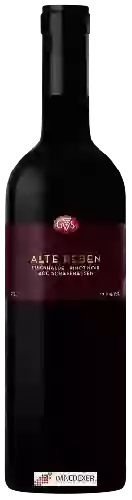
The Winery GVS Schachenmann is one of the largest wineries in the world. It offers 117 wines for sale in of Schaffhausen to come and discover on site or to buy online.
Looking for the best Winery GVS Schachenmann wines in Schaffhausen among all the wines in the region? Check out our tops of the best red, white or effervescent Winery GVS Schachenmann wines. Also find some food and wine pairings that may be suitable with the wines from this area. Learn more about the region and the Winery GVS Schachenmann wines with technical and enological descriptions.
How Winery GVS Schachenmann wines pair with each other generally quite well with dishes of beef, veal or game (deer, venison) such as recipes of roast beef with pepper, chicken with rice for cookeo robot or blanquette of rabbit with riesling and chanterelles.
On the nose the red wine of Winery GVS Schachenmann. often reveals types of flavors of non oak, earth or oak and sometimes also flavors of spices, red fruit or black fruit. In the mouth the red wine of Winery GVS Schachenmann. is a with a nice freshness.
Schaffhausen is a small canton (state) in northern Switzerland which for its Size produces a relatively large quantity of wine. Being the only Part of Switzerland to cross over the Rhein river, the canton of Schaffhausen is effectively an enclave of Switzerland in southern Germany, and this is Clear from the Germanic wine styles made here.
Roughly 70 percent of Schaffhausen wine is red. As with many German regions today, including neighboring Baden, it is made almost entirely from Pinot Noir (Blauburgunder to the German-speaking population here), with a minor supporting role played by the crossings Diolinoir and Garanoir.
White Schaffhausen wines are made from Müller-Thurgau - the most popular variety, plus Chasselas, Chardonnay, Kerner and Pinot Gris.
The Climate here is of continental type, with relatively Warm, Dry summers and cool winters. Schaffhausen has average rainfall for a Swiss canton and is one of the lowest-lying, being located almost 100 miles from (160km) from the Alps.
The Schaffhausen landscape is divided between two topographical areas: the gently meandering, forest-topped river valleys which characterize the Center and east of the canton, and the flatter land to the west close to the German border.
It is here – around the periphery of this lower-lying area, on the slopes above the villages of Hallau, Oberhallau, Trasadingen, Wilchingen and Wisental – that the key viticultural sites of Schaffhausen are to be found. They line the middle slopes of the surrounding hills, looking over the farms and villages below. In true Swiss style, these are neatly divided plots with well-maintained roads criss-crossing the slopes – reminiscent of those found in Lavaux, except that they are less vertiginous and without the views of Lake Geneva.
Wine production in the canton dates back to the Roman age, but was developed greatly by monks during the medieval period when it was regarded as one of Switzerlands most important wine regions.
How Winery GVS Schachenmann wines pair with each other generally quite well with dishes of pork, rich fish (salmon, tuna etc) or spicy food such as recipes of banh mi sandwich, tunisian bricks or lentil soup with carrots and coconut milk.
On the nose the white wine of Winery GVS Schachenmann. often reveals types of flavors of non oak, microbio or oak and sometimes also flavors of tree fruit, spices or citrus fruit. In the mouth the white wine of Winery GVS Schachenmann. is a powerful with a nice freshness.
The sylvaner is grown mainly in Germany and Alsace. The buds are somewhat cottony and the young leaves are green. The same applies to the ribbed branches. Once mature, the dominant colour is golden-green and small elliptical berries with small to medium-sized bunches can be seen. The ripe fruit is then adorned by five-lobed leaves. This variety is susceptible to chlorosis, gray mold, powdery mildew and mildew. It is also sensitive to frost and wind because of its long branches. It can be grown in any kind of soil, although it prefers stony, sandy and light soils. It is indeed moderately acidic and offers a complex set of aromas such as bitter almond, fruity and floral background. The taste has an excellent mixture of honey and candied or dried fruits.
How Winery GVS Schachenmann wines pair with each other generally quite well with dishes of veal, pork or game (deer, venison) such as recipes of sot- l- leaves, lentils and morteau sausages or rabbit italian style.
National Institute of Origin and Quality. French organization depending on the Ministry of Agriculture and in charge of quality signs: AOC, IGP, labels and organic farming.
How Winery GVS Schachenmann wines pair with each other generally quite well with dishes of veal, pork or game (deer, venison) such as recipes of roast veal with caramelized carrots, sauté of pork with chorizo or magret with pepper.
Merlot noir is a grape variety that originated in France (Bordeaux). It produces a variety of grape specially used for wine making. It is rare to find this grape to eat on our tables. This variety of grape is characterized by small to medium sized bunches, and medium sized grapes. Merlot noir can be found in many vineyards: South West, Languedoc & Roussillon, Cognac, Bordeaux, Loire Valley, Armagnac, Burgundy, Jura, Champagne, Rhone Valley, Beaujolais, Provence & Corsica, Savoie & Bugey.
Planning a wine route in the of Schaffhausen? Here are the wineries to visit and the winemakers to meet during your trip in search of wines similar to Winery GVS Schachenmann.
Pinot Blanc is a grape variety that originated in Burgundy, mutated from Pinot Gris. Today, it is grown in Alsace where it is called klevner when blended with auxerrois. The continental climate, with its cold winters and hot summers, is particularly suited to pinot blanc. It is resistant to frost in winter and in summer, the roots draw the minerals it needs from the warm soil. Its bunches are made up of small berries with thick skins and melting pulp that produce fruity, spicy wines, balanced between acidity and alcohol. pinot blanc is also used for crémants and sparkling wines. Pinot Blanc is also used for Crémant and sparkling wines. It is widely grown in Italy, where it covers almost 7,000 hectares, and is also found in Germany, Austria, Canada and South Africa.