The Winery Savian of Veneto
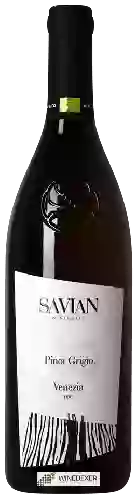
The Winery Savian is one of the world's great estates. It offers 39 wines for sale in of Veneto to come and discover on site or to buy online.
Looking for the best Winery Savian wines in Veneto among all the wines in the region? Check out our tops of the best red, white or effervescent Winery Savian wines. Also find some food and wine pairings that may be suitable with the wines from this area. Learn more about the region and the Winery Savian wines with technical and enological descriptions.
How Winery Savian wines pair with each other generally quite well with dishes of shellfish, vegetarian or mushrooms such as recipes of armorican-style squid, leek, goat cheese and bacon quiche or chicken with white wine and olives.
On the nose the white wine of Winery Savian. often reveals types of flavors of apples, melon or earth and sometimes also flavors of tree fruit, citrus fruit. In the mouth the white wine of Winery Savian. is a powerful with a nice freshness.
Veneto is an important and growing wine region in northeastern Italy. Veneto is administratively Part of the Triveneto area, aLong with its smaller neighbors, Trentino-Alto Adige and Friuli-Venezia Giulia. In terms of geography, culture and wine styles, it represents a transition from the Alpine and Germanic-Slavic end of Italy to the warmer, drier, more Roman lands to the South. Veneto is slightly smaller than the other major Italian wine regions - Piedmont, Tuscany, Lombardy, Puglia and Sicily - but it produces more wine than any of them.
Although the southern regions, Sicily and Puglia, have long been Italy's main wine producers, that Balance began to shift northward to the Veneto in the second half of the 20th century. In the 1990s, southern Italian wine languished in an increasingly competitive and demanding world, while the Veneto upped its Game">game, gaining recognition with wines such as Valpolicella, Amarone, Soave and Prosecco">Prosecco. With Fruity red Valpolicella complementing its intense Amarone and Sweet Recioto, the Veneto has a formidable portfolio of red wines to accompany its refreshing whites, like Soave and Sparkling Prosecco. Although most of the new vineyards that have enabled the Veneto to expand its wine production have been of dubious viticultural quality, today more than 25% of the region's wines are produced and sold under DOC/DOCG designations.
How Winery Savian wines pair with each other generally quite well with dishes of beef, lamb or game (deer, venison) such as recipes of chinese fondue, lamb biryani or rabbit in foil.
On the nose the red wine of Winery Savian. often reveals types of flavors of earth, oak or spices and sometimes also flavors of red fruit, dried fruit or black fruit. In the mouth the red wine of Winery Savian. is a powerful.
It is said to be of Slovenian origin, where it is cultivated under the name of Prosekar, also known for a long time in Italy under the name of Glera. It should not be confused with prosecco lungo - although there is a family link - and prosecco nostrano, which is none other than Tuscany's malvasia. Note that Vitouska - another Italian grape variety - is the result of a natural intraspecific cross between Tuscan malvasia and Prosecco. Under the name of Glera, it is registered in the Official Catalogue of wine grape varieties list A. It can be found in practically all of the former Yugoslavia, and more surprisingly in Argentina, but is virtually unknown in France.
How Winery Savian wines pair with each other generally quite well with dishes of shellfish, vegetarian or appetizers and snacks such as recipes of shrimps with curry and coconut milk, goat cheese and bacon quiche or bruschetta with mozzarella.
On the nose the sparkling wine of Winery Savian. often reveals types of flavors of tree fruit. In the mouth the sparkling wine of Winery Savian. is a with a nice vivacity and a fine and pleasant bubble.
Quantity of grapes harvested per hectare. In AOC, the average yield is limited on the proposal of the appellation syndicate, validated by the Inao. The use of high-performance plant material (especially clones) and better control of vine diseases have increased yields. This is not without consequences on the quality of the wines (dilution) and on the state of the market (too much wine). We must not over-simplify: low yields are not synonymous with quality, and it is often in years with generous harvests that we find the greatest vintages (1982 and 1986 in Bordeaux, 1996 in Champagne, 1990 and 2005 in Burgundy...).
How Winery Savian wines pair with each other generally quite well with dishes of veal, pork or game (deer, venison) such as recipes of filet mignon of veal with cider, pork roll with tomato sauce or duck confit (canned).
Cabernet Franc is one of the oldest red grape varieties in Bordeaux. The Libourne region is its terroir where it develops best. The terroirs of Saint-Emilion and Fronsac allow it to mature and develop its best range of aromas. It is also the majority in many blends. The very famous Château Cheval Blanc, for example, uses 60% Cabernet Franc. The wines produced with Cabernet Franc are medium in colour with fine tannins and subtle aromas of small red fruits and spices. When blended with Merlot and Cabernet Sauvignon, it brings complexity and a bouquet of aromas to the wine. It produces fruity wines that can be drunk quite quickly, but whose great vintages can be kept for a long time. It is an earlier grape variety than Cabernet Sauvignon, which means that it is planted as far north as the Loire Valley. In Anjou, it is also used to make sweet rosé wines. Cabernet Franc is now used in some twenty countries in Europe and throughout the world.
Planning a wine route in the of Veneto? Here are the wineries to visit and the winemakers to meet during your trip in search of wines similar to Winery Savian.
The white Chardonnay is a grape variety that originated in France (Burgundy). It produces a variety of grape specially used for wine making. It is rare to find this grape to eat on our tables. This variety of grape is characterized by small bunches, and small grapes. White Chardonnay can be found in many vineyards: South West, Burgundy, Jura, Languedoc & Roussillon, Cognac, Bordeaux, Beaujolais, Savoie & Bugey, Loire Valley, Champagne, Rhone Valley, Armagnac, Lorraine, Alsace, Provence & Corsica.