The Winery Conti Valli of Emilia-Romagna
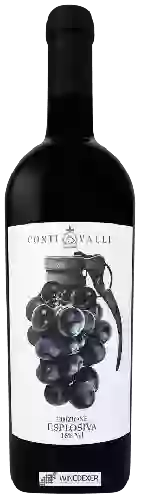
The Winery Conti Valli is one of the world's great estates. It offers 7 wines for sale in of Emilia-Romagna to come and discover on site or to buy online.

Looking for the best Winery Conti Valli wines in Emilia-Romagna among all the wines in the region? Check out our tops of the best red, white or effervescent Winery Conti Valli wines. Also find some food and wine pairings that may be suitable with the wines from this area. Learn more about the region and the Winery Conti Valli wines with technical and enological descriptions.
How Winery Conti Valli wines pair with each other generally quite well with dishes of beef, pasta or lamb such as recipes of monkfish (anglerfish) à la sétoise, fish with tamarind or 7 o'clock leg of lamb.
On the nose the red wine of Winery Conti Valli. often reveals types of flavors of non oak, earth or oak and sometimes also flavors of red fruit, black fruit. In the mouth the red wine of Winery Conti Valli. is a powerful with a lot of tannins present in the mouth.
Romagna/emilia">Emilia-Romagna is a Rich and fertile region in Northern Italy, and one of the country's most prolific wine-producing regions, with over 58,000 hectares (143,320 acres) of vines in 2010. It is 240 kilometers (150 miles) wide and stretches across almost the entire northern Italian peninsula, sandwiched between Tuscany to the South, Lombardy and Veneto to the north and the Adriatic Sea to the east. Nine miles of Liguria is all that separates Emilia-Romagna from the Ligurian Sea, and its uniqueness as the only Italian region with both an east and west coast. Emilia-Romagna's wine-growing heritage dates back to the seventh century BC, making it one of the oldest wine-growing regions in Italy.
Vines were introduced here by the Etruscans and then adopted by the Romans, who used the Via Aemilia (after which the region is named) to transport wine between towns. The Grape varieties used here for many centuries were of the Vitis labrusca species rather than the Vitis vinifera used worldwide today. The famous Lambrusco varieties of Emilia Romagna are derived from the Vitis labrusca species. Today, about 15 percent of the wine produced in Emilia-Romagna comes from the region's 20 or so DOCs, and only a tiny fraction from its two DOCGs (Albana di Romagna and Colli Bolognesi Classico Pignoletto).
How Winery Conti Valli wines pair with each other generally quite well with dishes such as recipes .
Auxerrois is a white grape variety native to Lorraine, which is also found in Alsace and in the Loire Valley, where it took off in 1950. Its name comes from the nurseries in Auxerre where it found refuge during the Second World War. Often called Pinot Auxerrois, it is part of the Moselle, Alsace and Côtes-de-Toul AOC grape varieties. Auxerrois should not be confused with côt or malbec, which are red grape varieties from the Cahors region and which may bear the same name. The bunches of Auxerrois are of medium size with small berries. It is a semi-late grape variety whose buds only come out when temperatures are well above 10°C. Auxerrois wines are characterized by finesse and acidity and subtle aromas of exotic fruits, fruits and white flowers. In France, it represents 1,600 hectares of production and some small parcels of Auxerrois are also present in Luxembourg, Germany, Canada and South Africa (2,300 hectares in total).
Planning a wine route in the of Emilia-Romagna? Here are the wineries to visit and the winemakers to meet during your trip in search of wines similar to Winery Conti Valli.
The douce noire, as its name indicates, is a black grape variety. It originated in the region between the valleys of the Isère and Saône rivers. Often in autumn, its foliage takes on a red hue. The bunches of the black sweet are larger than average. They are compact and winged. Spherical, its berries are of normal size. The flesh is juicy, soft and sweet. Although it is on the verge of extinction, this variety is still present in some Jura vineyards. Some call it corbeau, especially in Savoie, but it has other names such as gros noir, plant de Calarin and pecot. The sweet black is associated with an average budding and a late first ripening. Hardy and vigorous, it adapts to poorly irrigated soils. This variety produces a wine with low alcohol content, flat, soft and without much finesse. It should be consumed within the year. Sweet black is generally grown with Persian. It must be associated with other grape varieties to be better. Nowadays, this variety is not multiplied at all.