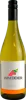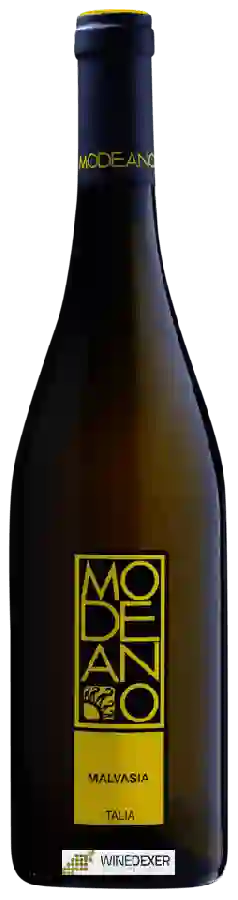
Winery ModeanoMalvasia
 White wine



In the mouth this white wine is a powerful.
This wine generally goes well with lean fish, shellfish or mature and hard cheese.
Taste structure of the Malvasia from the Winery Modeano
Light | Bold | |
Dry | Sweet | |
Soft | Acidic |
In the mouth the Malvasia of Winery Modeano in the region of Friuli-Venezia Giulia is a powerful.
Food and wine pairings with Malvasia
Pairings that work perfectly with Malvasia



Original food and wine pairings with Malvasia


The Malvasia of Winery Modeano matches generally quite well with dishes of pasta, shellfish or mature and hard cheese such as recipes of pasta "carbonara" à la française, curried mouclade à la charentaise or croque monsieur with 4 cheeses.
Details and technical informations about Winery Modeano's Malvasia.
Discover the grape variety: Glacière
Unknown, it is still found only in Vaucluse in most cases established in arbors (our photographs), never in culture. La Glacière is a table grape, not always pleasant to eat, that was once kept either on stumps or on racks for the winter. Today, it is very rare to find this variety, which has completely disappeared.
Last vintages of this wine
The best vintages of Malvasia from Winery Modeano are 0
Informations about the Winery Modeano
The Winery Modeano is one of of the world's greatest estates. It offers 16 wines for sale in the of Venezia Giulia to come and discover on site or to buy online.

The wine region of Venezia Giulia
The wine region of Venezia Giulia is located in the region of Frioul-Vénétie Julienne of Italy. Wineries and vineyards like the Domaine Lis Neris or the Domaine Gravner produce mainly wines white, red and pink. The most planted grape varieties in the region of Venezia Giulia are Merlot, Cabernet-Sauvignon and Chardonnay, they are then used in wines in blends or as a single variety. On the nose of Venezia Giulia often reveals types of flavors of earth, wax or jasmine and sometimes also flavors of grass, asparagus or thyme.
The wine region of Friuli-Venezia Giulia
Friuli-Venezia Giulia is an autonomous region in Italy, located in the extreme Northeast of the country, bordered by Austria and Slovenia to the north and east respectively. The eponymous wine region has four DOCGs, twelve DOCs and three PGIs and is best known for its white wine production. 77% of the region's wines are white, one of the highest proportions of any Italian region. The region's wines are distinctly different from other Italian wines in that they are made from non-traditional Grape varieties such as Sauvignon blanc, Riesling and Pinot blanc, as well as typically Italian varieties such as pinot gris and picolit.
The word of the wine: Burgundy piece
228-litre barrel.