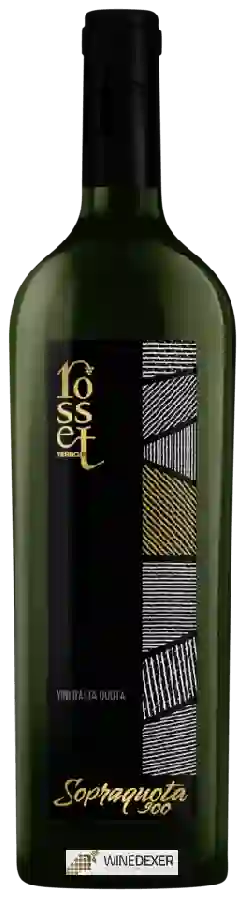
Winery RossetSopraquota 900
 White wine


In the mouth this white wine is a powerful with a nice freshness.
This wine generally goes well with lean fish, shellfish or mature and hard cheese.
The Sopraquota 900 of the Winery Rosset is in the top 30 of wines of Valle d'Aosta.

Taste structure of the Sopraquota 900 from the Winery Rosset
Light | Bold | |
Dry | Sweet | |
Soft | Acidic |
In the mouth the Sopraquota 900 of Winery Rosset in the region of Valle d'Aosta is a powerful with a nice freshness.
Wine flavors and olphactive analysis


On the nose the Sopraquota 900 of Winery Rosset in the region of Valle d'Aosta often reveals types of flavors of earth.
Food and wine pairings with Sopraquota 900
Pairings that work perfectly with Sopraquota 900



Original food and wine pairings with Sopraquota 900


The Sopraquota 900 of Winery Rosset matches generally quite well with dishes of pasta, shellfish or mature and hard cheese such as recipes of leek pie, creamy tomato squid or auvergne fondue with ceps.
Details and technical informations about Winery Rosset's Sopraquota 900.
Discover the grape variety: Ahmeur bou A(h)meur
Table grape with large bunches and juicy, crunchy grey-pink berries, firm flesh and pleasant sweet flavour. Late ripening, sensitive to winter frost. Rarely vinified; grown mainly as a table grape in warm regions and on trellises beside Mediterranean homes. Still found in North Africa, California, Argentina, Spain and Portugal. Grey variety of probable North African or Spanish origin.
Last vintages of this wine

The best vintages of Sopraquota 900 from Winery Rosset are 2019, 2018, 2017, 0 and 2016.
Informations about the Winery Rosset
The Winery Rosset is one of of the world's greatest estates. It offers 10 wines for sale in the of Valle d'Aosta to come and discover on site or to buy online.

The wine region of Valle d'Aosta
Italy's smallest vineyard (~500 ha) between Mont Blanc and Canavese, among Europe's highest vines (up to 1,200 m at Morgex). Native Petit Rouge signature: fine, fresh reds with signature notes of raspberry, violet, alpine herbs, sweet spices and a mineral touch, silky tannins. Local Cornalin, Fumin and Mayolet complete. Firm Nebbiolo (Picotendro), light Gamay.
The word of the wine: Lyon pot
A 46 cl bottle with a thick bottom, typical of the Lyon region, especially used to serve Beaujolais wines drawn from the barrel.