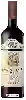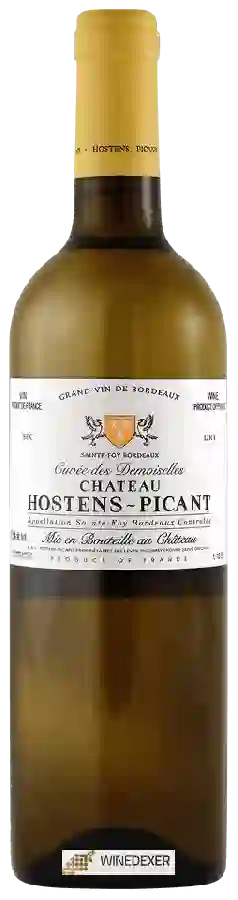
Château Hostens-PicantCuvée des Demoiselles Sainte-Foy-Bordeaux
 White wine


In the mouth this white wine is a powerful.
This wine generally goes well with pork, vegetarian or poultry.
The Cuvée des Demoiselles Sainte-Foy-Bordeaux of the Château Hostens-Picant is in the top 5 of wines of Sainte-Foy-Bordeaux.
Taste structure of the Cuvée des Demoiselles Sainte-Foy-Bordeaux from the Château Hostens-Picant
Light | Bold | |
Dry | Sweet | |
Soft | Acidic |
In the mouth the Cuvée des Demoiselles Sainte-Foy-Bordeaux of Château Hostens-Picant in the region of Bordeaux is a powerful.
Wine flavors and olphactive analysis






On the nose the Cuvée des Demoiselles Sainte-Foy-Bordeaux of Château Hostens-Picant in the region of Bordeaux often reveals types of flavors of pineapple, cream or oaky and sometimes also flavors of tropical, citrus or peach.
Food and wine pairings with Cuvée des Demoiselles Sainte-Foy-Bordeaux
Pairings that work perfectly with Cuvée des Demoiselles Sainte-Foy-Bordeaux



Original food and wine pairings with Cuvée des Demoiselles Sainte-Foy-Bordeaux


The Cuvée des Demoiselles Sainte-Foy-Bordeaux of Château Hostens-Picant matches generally quite well with dishes of pork, vegetarian or poultry such as recipes of barbecued filet mignon, tuna, pepper and tomato quiche or savoyard fondue.
Details and technical informations about Château Hostens-Picant's Cuvée des Demoiselles Sainte-Foy-Bordeaux.
Discover the grape variety: Knipperlé
Knipperlé blanc is a grape variety that originated in France (Alsace). It produces a variety of grape specially used for wine making. It is rare to find this grape to eat on our tables. This variety of grape is characterized by small to medium sized bunches and small to medium sized grapes. Knipperlé blanc can be found cultivated in these vineyards: South West, Cognac, Bordeaux, Provence & Corsica, Rhone Valley.
Last vintages of this wine

The best vintages of Cuvée des Demoiselles Sainte-Foy-Bordeaux from Château Hostens-Picant are 2015, 2016, 2014, 2011 and 2010.
Informations about the Château Hostens-Picant
The Château Hostens-Picant is one of of the world's greatest estates. It offers 11 wines for sale in the of Sainte-Foy-Bordeaux to come and discover on site or to buy online.

The wine region of Sainte-Foy-Bordeaux
The wine region of Sainte-Foy-Bordeaux is located in the region of Entre-deux-Mers of Bordeaux of France. Wineries and vineyards like the Château Martet or the Château Hostens-Picant produce mainly wines red, white and sweet. The most planted grape varieties in the region of Sainte-Foy-Bordeaux are Merlot, Cabernet-Sauvignon and Cabernet franc, they are then used in wines in blends or as a single variety. On the nose of Sainte-Foy-Bordeaux often reveals types of flavors of tobacco, tropical fruit or lime and sometimes also flavors of apricot, pear or stone.
The wine region of Bordeaux
Bordeaux, in southwestern France, is one of the most famous, prestigious and prolific wine regions in the world. The majority of Bordeaux wines (nearly 90% of the production Volume) are the Dry, medium and Full-bodied red Bordeaux blends for which it is famous. The finest (and most expensive) are the wines of the great châteaux of Haut-Médoc and the right bank appellations of Saint-Émilion and Pomerol. The former focuses (at the highest level) on Cabernet Sauvignon, the latter on Merlot.
The word of the wine: Dress
Visual aspect of the wine. The colour is defined by its intensity, clarity, brilliance and colour, which indicate the level of evolution of the wine, thus giving an indication of its vintage.