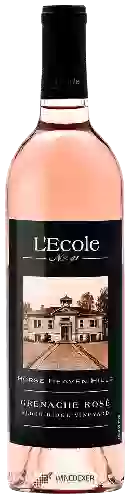
The Winery L'Ecole No 41 of Columbia Valley of Washington

Winery L'Ecole No 41
The winery offers 39 different wines
3.9
Note - 1Note - 1Note - 1Note - 1Note - 0
Its wines get an average rating of 3.9.
It is ranked in the top 31 of the estates of Washington.
It is located in Columbia Valley in the region of Washington
Find the Winery L'Ecole No 41 on Facebook and on Twitter

The Winery L'Ecole No 41 is one of the world's great estates. It offers 39 wines for sale in of Columbia Valley to come and discover on site or to buy online.

Top Winery L'Ecole No 41 wines

Looking for the best Winery L'Ecole No 41 wines in Columbia Valley among all the wines in the region? Check out our tops of the best red, white or effervescent Winery L'Ecole No 41 wines. Also find some food and wine pairings that may be suitable with the wines from this area. Learn more about the region and the Winery L'Ecole No 41 wines with technical and enological descriptions.

The top pink wines of Winery L'Ecole No 41

Food and wine pairings with a pink wine of Winery L'Ecole No 41

How Winery L'Ecole No 41 wines pair with each other generally quite well with dishes of beef or mature and hard cheese such as recipes of kafta bil saniyeh (lebanese dish) or truffle with cantal and saint-nectaire cheese.

Organoleptic analysis of pink wines of Winery L'Ecole No 41

On the nose the pink wine of Winery L'Ecole No 41. often reveals types of flavors of earth, microbio or tree fruit and sometimes also flavors of red fruit.

The best vintages in the pink wines of Winery L'Ecole No 41

  • 2018With an average score of 4.00/5
  • 2017With an average score of 3.90/5
  • 0With an average score of 3.90/5
  • 2019With an average score of 3.90/5
  • 2016With an average score of 3.50/5

The grape varieties most used in the pink wines of Winery L'Ecole No 41.

  • Grenache

Discovering the wine region of Columbia Valley

The wine region of Columbia Valley is located in the region of Washington of United States. We currently count 841 estates and châteaux in the of Columbia Valley, producing 3147 different wines in conventional, organic and biodynamic agriculture. The wines of Columbia Valley go well with generally quite well with dishes .

The top red wines of Winery L'Ecole No 41

Food and wine pairings with a red wine of Winery L'Ecole No 41

How Winery L'Ecole No 41 wines pair with each other generally quite well with dishes of beef, pasta or veal such as recipes of stewed beef heart, pasta with peas and bacon or white wine fondue.

Organoleptic analysis of red wines of Winery L'Ecole No 41

On the nose the red wine of Winery L'Ecole No 41. often reveals types of flavors of non oak, earth or microbio and sometimes also flavors of vegetal, oak or spices. In the mouth the red wine of Winery L'Ecole No 41. is a powerful with a nice balance between acidity and tannins.

The best vintages in the red wines of Winery L'Ecole No 41

  • 2005With an average score of 4.16/5
  • 2004With an average score of 4.10/5
  • 2013With an average score of 4.07/5
  • 2017With an average score of 4.06/5
  • 2015With an average score of 4.02/5
  • 2006With an average score of 4.01/5

The grape varieties most used in the red wines of Winery L'Ecole No 41.

  • Cabernet Sauvignon
  • Merlot
  • Cabernet Franc
  • Shiraz/Syrah
  • Malbec
  • Grenache

Discover the grape variety: Cabernet franc

Cabernet Franc is one of the oldest red grape varieties in Bordeaux. The Libourne region is its terroir where it develops best. The terroirs of Saint-Emilion and Fronsac allow it to mature and develop its best range of aromas. It is also the majority in many blends. The very famous Château Cheval Blanc, for example, uses 60% Cabernet Franc. The wines produced with Cabernet Franc are medium in colour with fine tannins and subtle aromas of small red fruits and spices. When blended with Merlot and Cabernet Sauvignon, it brings complexity and a bouquet of aromas to the wine. It produces fruity wines that can be drunk quite quickly, but whose great vintages can be kept for a long time. It is an earlier grape variety than Cabernet Sauvignon, which means that it is planted as far north as the Loire Valley. In Anjou, it is also used to make sweet rosé wines. Cabernet Franc is now used in some twenty countries in Europe and throughout the world.

The top white wines of Winery L'Ecole No 41

Food and wine pairings with a white wine of Winery L'Ecole No 41

How Winery L'Ecole No 41 wines pair with each other generally quite well with dishes of pork, rich fish (salmon, tuna etc) or vegetarian such as recipes of croque madame, sublime salmon (stuffed salmon) or ham and comté quiche.

Organoleptic analysis of white wines of Winery L'Ecole No 41

On the nose the white wine of Winery L'Ecole No 41. often reveals types of flavors of non oak, earth or microbio and sometimes also flavors of vegetal, oak or tree fruit. In the mouth the white wine of Winery L'Ecole No 41. is a powerful with a nice freshness.

The best vintages in the white wines of Winery L'Ecole No 41

  • 2019With an average score of 3.91/5
  • 2011With an average score of 3.84/5
  • 2013With an average score of 3.81/5
  • 2014With an average score of 3.79/5
  • 2018With an average score of 3.77/5
  • 2016With an average score of 3.76/5

The grape varieties most used in the white wines of Winery L'Ecole No 41.

  • Sémillon
  • Chardonnay
  • Chenin Blanc
  • Sauvignon Blanc

The word of the wine: Alcohol content

Quantity of alcohol in wine and in all alcoholic beverages, expressed in degrees or as a percentage.

Discover other wineries and winemakers neighboring the Winery L'Ecole No 41

Planning a wine route in the of Columbia Valley? Here are the wineries to visit and the winemakers to meet during your trip in search of wines similar to Winery L'Ecole No 41.

Discover the grape variety: Chenin blanc

It most certainly originates from the Anjou region and is registered in the official catalogue of wine grape varieties on the A1 list. It can also be found in South Africa, Australia, Argentina, Chile, the United States (California), New Zealand, etc. It is said to be a descendant of Savagnin and to have sauvignonasse as its second parent (Jean-Michel Boursiquot 2019). On the other hand, Chenin blanc is the half-brother of verdelho and sauvignon blanc and is the father of colombard.