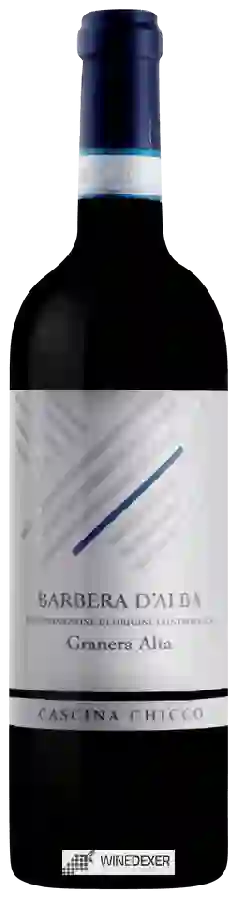
Winery Cascina ChiccoBarbera d'Alba Granera Alta
 Red wine



In the mouth this red wine is a powerful with a nice freshness.
This wine generally goes well with pork, poultry or veal.

Taste structure of the Barbera d'Alba Granera Alta from the Winery Cascina Chicco
Light | Bold | |
Smooth | Tannic | |
Dry | Sweet | |
Soft | Acidic |
In the mouth the Barbera d'Alba Granera Alta of Winery Cascina Chicco in the region of Piedmont is a powerful with a nice freshness.
Wine flavors and olphactive analysis






On the nose the Barbera d'Alba Granera Alta of Winery Cascina Chicco in the region of Piedmont often reveals types of flavors of non oak, earth or microbio and sometimes also flavors of vegetal, oak or spices.
Food and wine pairings with Barbera d'Alba Granera Alta
Pairings that work perfectly with Barbera d'Alba Granera Alta



Original food and wine pairings with Barbera d'Alba Granera Alta


The Barbera d'Alba Granera Alta of Winery Cascina Chicco matches generally quite well with dishes of pasta, veal or pork such as recipes of pasta shells, blanquette of veal or turkey roulades, flavoured sauce.
Details and technical informations about Winery Cascina Chicco's Barbera d'Alba Granera Alta.
Discover the grape variety: Couderc 4401
Coloured, simple fruity reds with a light purple robe, soft tannins and an airy palate, showing undemanding aromas of red and black fruits. Productive. Marginal today, surviving in a few French varietal collections, it testifies to the history of post-phylloxera hybridisation. French black hybrid bred by Georges Couderc at the end of the 19th century, in the lineage of phylloxera-resistant crosses.
Last vintages of this wine
The best vintages of Barbera d'Alba Granera Alta from Winery Cascina Chicco are 2019, 2007, 2016, 2014 and 2017.
Informations about the Winery Cascina Chicco
The Winery Cascina Chicco is one of of the world's greatest estates. It offers 19 wines for sale in the of Barbera d'Alba to come and discover on site or to buy online.

The wine region of Barbera d'Alba
Premium Piedmontese Barbera around Alba (heart of the Langhe). Fleshier, more concentrated reds than neighbouring Asti, with signature notes of ripe black cherry, candied plum, violet and sweet spices, characteristic fresh acidity and round tannins. Frequent barrel ageing (chocolate, vanilla). Generous palate, accessible young, age-worthy Superiore versions.
The wine region of Piedmont
Kingdom of Nebbiolo: Barolo and Barbaresco DOCG, long-ageing reds with firm tannins and lively acidity, complex aromas of withered rose, sour cherry, tar, truffle and undergrowth. More accessible, tangy Barbera on red fruit, supple, crisp Dolcetto. Sweet, floral sparkling Moscato d'Asti, mineral, lemony Gavi (Cortese) white, round, almondy Arneis from Roero. 50,000 ha across the Langhe, Roero and Monferrato, UNESCO.
The word of the wine: Old vines
There are no specific regulations governing the term "vieilles vignes". After 20 to 25 years, the yields stabilize and tend to decrease, the vines are deeply rooted, and the grapes that come from them give richer, more concentrated, more sappy wines, expressing with more nuance the characteristics of their terroir. It is possible to find plots of vines that claim to be a century old.