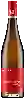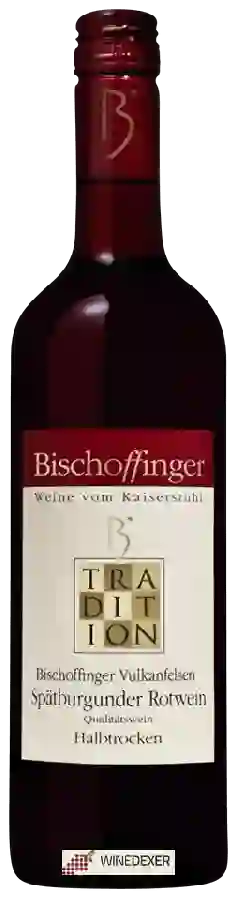
Winery BischoffingerTradition Vulkanfelsen Spätburgunder Halbtrocken
 Red wine


In the mouth this red wine is a with a nice freshness.
This wine generally goes well with poultry, beef or veal.
Taste structure of the Tradition Vulkanfelsen Spätburgunder Halbtrocken from the Winery Bischoffinger
Light | Bold | |
Smooth | Tannic | |
Dry | Sweet | |
Soft | Acidic |
In the mouth the Tradition Vulkanfelsen Spätburgunder Halbtrocken of Winery Bischoffinger in the region of Baden is a with a nice freshness.
Food and wine pairings with Tradition Vulkanfelsen Spätburgunder Halbtrocken
Pairings that work perfectly with Tradition Vulkanfelsen Spätburgunder Halbtrocken



Original food and wine pairings with Tradition Vulkanfelsen Spätburgunder Halbtrocken

The Tradition Vulkanfelsen Spätburgunder Halbtrocken of Winery Bischoffinger matches generally quite well with dishes of beef, veal or game (deer, venison) such as recipes of family potluck, alsatian wine pie or venison stew.
Details and technical informations about Winery Bischoffinger's Tradition Vulkanfelsen Spätburgunder Halbtrocken.
Discover the grape variety: Alvina
Intraspecific crossing obtained between Alphonse Lavallée and the white sultana, registered in 1990 in the Official Catalogue of table grape varieties list A1.
Last vintages of this wine
The best vintages of Tradition Vulkanfelsen Spätburgunder Halbtrocken from Winery Bischoffinger are 2016
Informations about the Winery Bischoffinger
The Winery Bischoffinger is one of of the world's great estates. It offers 95 wines for sale in the of Baden to come and discover on site or to buy online.

The wine region of Baden
Baden is the southernmost of Germany's 13 official wine regions. It is also the warmest. Its relatively sunny, DryClimate permits the production of good-quality Spätburgunder (Pinot Noir) and ripe, relatively Full-bodied">Full-bodied examples of Grauburgunder (Pinot Gris) and Weissburgunder (Pinot Blanc). These are often made in oaked styles.
The word of the wine: Erinosis
Generally benign condition caused by a very small mite. The infested leaves show blisters on the upper surface, sometimes reddish, sometimes green, to which corresponds on the lower surface a dense felting, first pinkish white, then brownish or reddish.