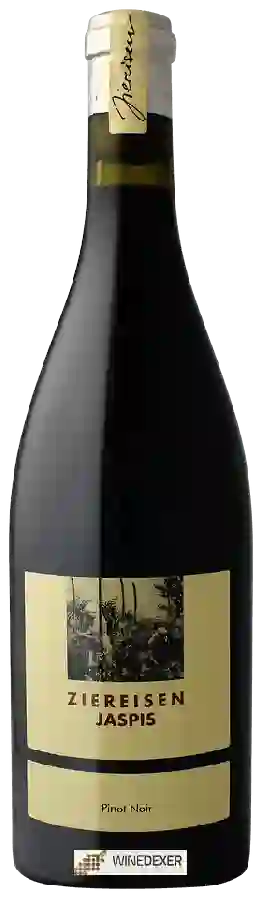
Winery ZiereisenJaspis Pinot Noir
 Red wine


In the mouth this red wine is a with a nice freshness.
This wine generally goes well with poultry, beef or veal.
The Jaspis Pinot Noir of the Winery Ziereisen is in the top 20 of wines of Baden.

Taste structure of the Jaspis Pinot Noir from the Winery Ziereisen
Light | Bold | |
Smooth | Tannic | |
Dry | Sweet | |
Soft | Acidic |
In the mouth the Jaspis Pinot Noir of Winery Ziereisen in the region of Baden is a with a nice freshness.
Wine flavors and olphactive analysis




On the nose the Jaspis Pinot Noir of Winery Ziereisen in the region of Baden often reveals types of flavors of earth, oak or spices and sometimes also flavors of red fruit, black fruit.
Food and wine pairings with Jaspis Pinot Noir
Pairings that work perfectly with Jaspis Pinot Noir



Original food and wine pairings with Jaspis Pinot Noir

The Jaspis Pinot Noir of Winery Ziereisen matches generally quite well with dishes of beef, veal or game (deer, venison) such as recipes of barbecued prime rib with coarse salt, braised veal heart with carrots or rabbit with goat cheese and mint.
Details and technical informations about Winery Ziereisen's Jaspis Pinot Noir.
Discover the grape variety: Pinot noir
Elegant reds, light in colour with silky tannins, showing strawberry, cherry and raspberry aromas, evolving to forest floor, mushroom and spice with age. Fresh acidity, delicate finish. Star of the Côte d'Or (Romanée-Conti, Chambertin, Volnay), pillar of Champagne (Blanc de Noirs) and signature of Oregon, Central Otago and Sonoma Coast. An early-ripening Burgundian variety, one of the world's greatest.
Last vintages of this wine

The best vintages of Jaspis Pinot Noir from Winery Ziereisen are 2012, 2016, 2015, 2014 and 2008.
Informations about the Winery Ziereisen
The Winery Ziereisen is one of of the world's greatest estates. It offers 43 wines for sale in the of Baden to come and discover on site or to buy online.

The wine region of Baden
German capital of Pinot Noir (Spätburgunder): silky, fine reds with notes of red fruits, cherry, undergrowth and sweet spices, melted tannins. Round Grauburgunder (Pinot Gris), lively Weissburgunder, supple Müller-Thurgau, mineral Riesling. Germany's 3rd region (15,000 ha) in Baden-Württemberg facing Alsace, one of the country's warmest climates, volcanic soils at the Kaiserstuhl. Cradle of modern great German reds, elegant and fine.
The word of the wine: Tartar (deposit)
White, chalky deposits that occur as a result of precipitation inside bottles and are often considered by consumers as a defect. They are in fact tartaric salts formed by tartaric acid, potassium and calcium naturally present in the wine. This deposit does not alter the quality of the wine and can be eliminated by a simple decanting.