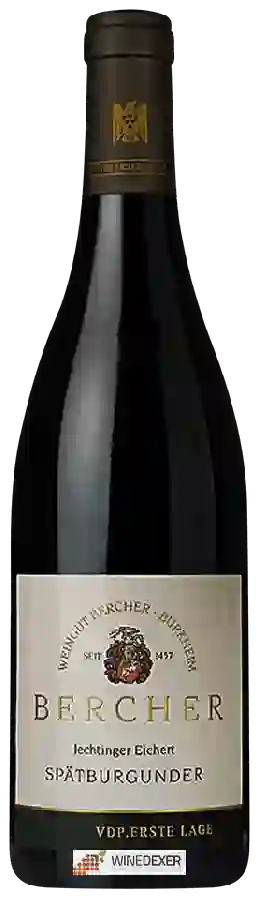
Weingut BercherJechtinger Eichert Spätburgunder
 Red wine



In the mouth this red wine is a with a nice freshness.
This wine generally goes well with poultry, beef or veal.

Taste structure of the Jechtinger Eichert Spätburgunder from the Weingut Bercher
Light | Bold | |
Smooth | Tannic | |
Dry | Sweet | |
Soft | Acidic |
In the mouth the Jechtinger Eichert Spätburgunder of Weingut Bercher in the region of Baden is a with a nice freshness.
Wine flavors and olphactive analysis



On the nose the Jechtinger Eichert Spätburgunder of Weingut Bercher in the region of Baden often reveals types of flavors of non oak, earth or oak and sometimes also flavors of red fruit.
Food and wine pairings with Jechtinger Eichert Spätburgunder
Pairings that work perfectly with Jechtinger Eichert Spätburgunder



Original food and wine pairings with Jechtinger Eichert Spätburgunder

The Jechtinger Eichert Spätburgunder of Weingut Bercher matches generally quite well with dishes of beef, veal or game (deer, venison) such as recipes of simple baked roast beef, italian veal roulade or venison leg with tomato sauce.
Details and technical informations about Weingut Bercher's Jechtinger Eichert Spätburgunder.
Discover the grape variety: Cabernet-Cantor
Colourful and simply fruity reds with a deep purple hue, supple tannins and an ample palate with preserved acidity, featuring signature aromas of black fruits (blackcurrant, blackberry), green pepper and herbaceous notes reminiscent of Cabernet. Productive and resistant. Grown in Germany, Belgium and the United Kingdom for northern organic vineyards. German black hybrid grape obtained in 1987 at Geilweilerhof, a disease-resistant crossing involving Cabernet Sauvignon.
Last vintages of this wine
The best vintages of Jechtinger Eichert Spätburgunder from Weingut Bercher are 0, 2015
Informations about the Weingut Bercher
The Weingut Bercher is one of of the world's great estates. It offers 69 wines for sale in the of Baden to come and discover on site or to buy online.

The wine region of Baden
German capital of Pinot Noir (Spätburgunder): silky, fine reds with notes of red fruits, cherry, undergrowth and sweet spices, melted tannins. Round Grauburgunder (Pinot Gris), lively Weissburgunder, supple Müller-Thurgau, mineral Riesling. Germany's 3rd region (15,000 ha) in Baden-Württemberg facing Alsace, one of the country's warmest climates, volcanic soils at the Kaiserstuhl. Cradle of modern great German reds, elegant and fine.
The word of the wine: Ugni blanc
White grape variety of Italian origin, and the main white variety grown in France. Its large bunches give fine, light and lively wines, suitable for distillation: today it is the main variety for making cognac and armagnac. Ugni blanc, which is a little richer in alcohol when grown in Mediterranean regions, is used in the blending of the Provence and Corsica appellations, often in association with other grape varieties that bring aromas and structure, such as clairette, grenache blanc or sauvignon. Ugni blanc is also used, on a secondary basis, in the production of certain white wines in Gironde (AOC Bordeaux, Entre-deux-Mers, etc.).