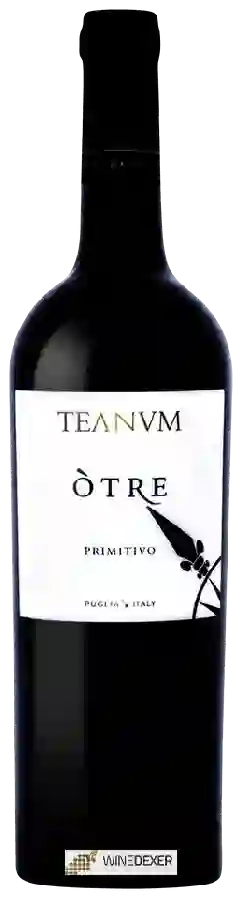
Winery TeanumÒtre Primitivo
 Red wine


This wine is composed of 100% of the grape variety Primitivo.
In the mouth this red wine is a powerful.
This wine generally goes well with poultry, beef or lamb.

Taste structure of the Òtre Primitivo from the Winery Teanum
Light | Bold | |
Smooth | Tannic | |
Dry | Sweet | |
Soft | Acidic |
In the mouth the Òtre Primitivo of Winery Teanum in the region of Puglia is a powerful.
Wine flavors and olphactive analysis





On the nose the Òtre Primitivo of Winery Teanum in the region of Puglia often reveals types of flavors of cherry, oaky or earthy and sometimes also flavors of blackberry, red fruit or vanilla.
Food and wine pairings with Òtre Primitivo
Pairings that work perfectly with Òtre Primitivo



Original food and wine pairings with Òtre Primitivo

The Òtre Primitivo of Winery Teanum matches generally quite well with dishes of beef, pasta or lamb such as recipes of borscht (russia), chinese noodles with vegetables and spices or leg with a spoon or seven o'clock leg.
Details and technical informations about Winery Teanum's Òtre Primitivo.
Discover the grape variety: Primitivo
Powerful, sun-drenched reds with a dark robe and generous alcohol, showing aromas of stewed blackberry, stewed plum, dried fig, chocolate, gentle spice and balsamic notes. Supple tannins, indulgent finish. Star of Puglia with Primitivo di Manduria DOC, Gioia del Colle DOC and Salice Salentino. Identical to American Zinfandel and Croatian Crljenak Kaštelanski by DNA analysis.
Last vintages of this wine

The best vintages of Òtre Primitivo from Winery Teanum are 2017, 2016, 2014, 2015 and 2013.
Informations about the Winery Teanum
The Winery Teanum is one of of the world's greatest estates. It offers 76 wines for sale in the of Puglia to come and discover on site or to buy online.

The wine region of Puglia
Heel of the boot, 80% red vineyard, sunny and generous. Fleshy, jammy Primitivo (= Zinfandel) with notes of black cherry, plum, chocolate and spices, powerful alcohol and melted tannins, a star in Primitivo di Manduria. Deep, structured Negroamaro (black-bitter) with a bitter finish in Salice Salentino. Structured Nero di Troia, spicy Susumaniello.
The word of the wine: Malolactic fermentation
Called second fermentation or malo for short. It is the degradation (under the effect of bacteria) of the malic acid naturally present in the wine into milder, less aggressive lactic acid. Some producers or wineries refuse this operation by "blocking the malo" (by cold and adding SO2) to keep a maximum of acidity which carries the aromas and accentuates the sensation of freshness.