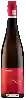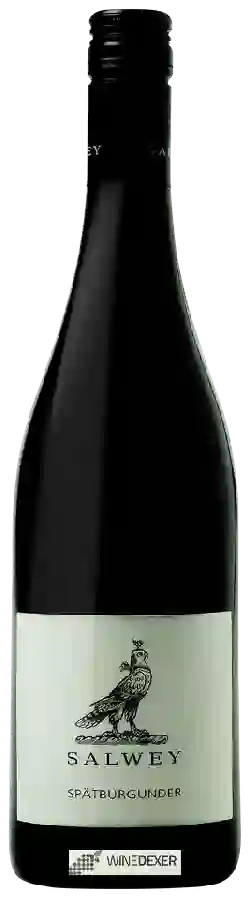
Winery SalweySpätburgunder
 Red wine



In the mouth this red wine is a with a nice freshness.
This wine generally goes well with poultry, beef or veal.

Taste structure of the Spätburgunder from the Winery Salwey
Light | Bold | |
Smooth | Tannic | |
Dry | Sweet | |
Soft | Acidic |
In the mouth the Spätburgunder of Winery Salwey in the region of Baden is a with a nice freshness.
Wine flavors and olphactive analysis






On the nose the Spätburgunder of Winery Salwey in the region of Baden often reveals types of flavors of cherry, oaky or smoke and sometimes also flavors of earthy, blackberry or minerality.
Food and wine pairings with Spätburgunder
Pairings that work perfectly with Spätburgunder



Original food and wine pairings with Spätburgunder

The Spätburgunder of Winery Salwey matches generally quite well with dishes of beef, veal or game (deer, venison) such as recipes of baked marrow bones, veal shank in a pot au feu with star anise or sarthe pot.
Details and technical informations about Winery Salwey's Spätburgunder.
Discover the grape variety: Cabernet-Severnyi
Deep-coloured, fruity reds with a dark ruby colour, moderate tannins and a direct palate; signature aromas of red fruits (cherry, raspberry), gentle spices and herbal notes typical of disease-resistant hybrids. Early-ripening northern profile. Grown in Russia, Ukraine and Eastern Europe in extreme continental vineyards. Russian black hybrid obtained in 1959, involving Cabernet Sauvignon.
Last vintages of this wine
The best vintages of Spätburgunder from Winery Salwey are 2009, 2013, 2018, 2010 and 2008.
Informations about the Winery Salwey
The Winery Salwey is one of of the world's greatest estates. It offers 69 wines for sale in the of Baden to come and discover on site or to buy online.

The wine region of Baden
German capital of Pinot Noir (Spätburgunder): silky, fine reds with notes of red fruits, cherry, undergrowth and sweet spices, melted tannins. Round Grauburgunder (Pinot Gris), lively Weissburgunder, supple Müller-Thurgau, mineral Riesling. Germany's 3rd region (15,000 ha) in Baden-Württemberg facing Alsace, one of the country's warmest climates, volcanic soils at the Kaiserstuhl. Cradle of modern great German reds, elegant and fine.
The word of the wine: Maturing (champagne)
After riddling, the bottles are stored on "point", upside down, with the neck of one bottle in the bottom of the other. The duration of this maturation is very important: in contact with the dead yeasts, the wine takes on subtle aromas and gains in roundness and fatness. A brut without year must remain at least 15 months in the cellar after bottling, a vintage 36 months.