The Winery Quails' Gate of Okanagan Valley of British Columbia
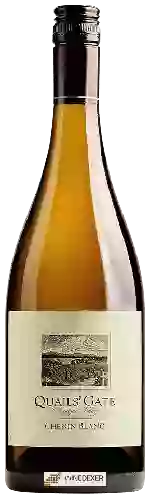
The Winery Quails' Gate is one of the largest wineries in the world. It offers 40 wines for sale in of Okanagan Valley to come and discover on site or to buy online.
Looking for the best Winery Quails' Gate wines in Okanagan Valley among all the wines in the region? Check out our tops of the best red, white or effervescent Winery Quails' Gate wines. Also find some food and wine pairings that may be suitable with the wines from this area. Learn more about the region and the Winery Quails' Gate wines with technical and enological descriptions.
How Winery Quails' Gate wines pair with each other generally quite well with dishes of shellfish, lean fish or fruity desserts such as recipes of yakisoba (fried noodles), fish pot or apple cake.
On the nose the white wine of Winery Quails' Gate. often reveals types of flavors of pineapple, cream or grapefruit and sometimes also flavors of oaky, tropical or citrus. In the mouth the white wine of Winery Quails' Gate. is a powerful with a nice freshness.
The Okanagan Valley is one of six Designated Viticultural Areas in the Canadian province of British Columbia. The DryClimate in this "pocket desert" produces some unique wines made from Merlot, Cabernet Sauvignon, Riesling, Pinot Noir, Pinot Blanc, Pinot Gris and Chardonnay.
There is now an almost even split between white and red grapes planted, with Merlot the most common variety. Ice wine can be produced in the Okanagan Valley but the necessary temperatures are not as consistent as on the east coast, where the winters are much colder.
The DVA produces more than 80 percent of the province's output and is the second most prolific wine region in Canada, behind Ontario's Niagara Peninsula. There are around 185 licensed grape wineries and 3,575 hectares (8,830 acres) of vineyards.
The Long, narrow Okanagan Valley runs for around 210 kilometers (130 miles) from the Northern town of Salmon Arm to the border of the United States in the South. Much of the viticulture occurs in the Center of the region on the shores of Lake Okanagan, from which the area takes its name.
The Okanagan river then flows south into the US state of Washington, where it converges with the viticulturally significant Columbia River (home to the extensive Columbia Valley AVA). The river is spelled Okonogan in the United States.
Unlike in the fragmented Niagara Peninsula appellation, the Okanagan Valley forms just one designated viticultural area. However, the diversity of Terroir here means there are a number of subregions within it.
How Winery Quails' Gate wines pair with each other generally quite well with dishes of beef, lamb or poultry such as recipes of grandma melanie's cassoulet, lamb with coconut milk or basque chicken.
On the nose the red wine of Winery Quails' Gate. often reveals types of flavors of non oak, earth or microbio and sometimes also flavors of oak, tree fruit or spices. In the mouth the red wine of Winery Quails' Gate. is a powerful with a nice freshness.
It most certainly originates from the Anjou region and is registered in the official catalogue of wine grape varieties on the A1 list. It can also be found in South Africa, Australia, Argentina, Chile, the United States (California), New Zealand, etc. It is said to be a descendant of Savagnin and to have sauvignonasse as its second parent (Jean-Michel Boursiquot 2019). On the other hand, Chenin blanc is the half-brother of verdelho and sauvignon blanc and is the father of colombard.
How Winery Quails' Gate wines pair with each other generally quite well with dishes such as recipes .
On the nose the natural sweet wine of Winery Quails' Gate. often reveals types of flavors of non oak, earth or microbio and sometimes also flavors of oak, spices or red fruit.
A pleasant smell that can be primary (or varietal, i.e. characteristic of the grape), secondary (resulting from fermentation) or tertiary (resulting from the aging of the wine in the bottle).
How Winery Quails' Gate wines pair with each other generally quite well with dishes of veal, pork or game (deer, venison) such as recipes of lamb confit with new potatoes, rabbit in white wine (casserole) or confit sausages.
On the nose the pink wine of Winery Quails' Gate. often reveals types of flavors of microbio, vegetal or oak and sometimes also flavors of tree fruit, citrus fruit or red fruit.
Cabernet Franc is one of the oldest red grape varieties in Bordeaux. The Libourne region is its terroir where it develops best. The terroirs of Saint-Emilion and Fronsac allow it to mature and develop its best range of aromas. It is also the majority in many blends. The very famous Château Cheval Blanc, for example, uses 60% Cabernet Franc. The wines produced with Cabernet Franc are medium in colour with fine tannins and subtle aromas of small red fruits and spices. When blended with Merlot and Cabernet Sauvignon, it brings complexity and a bouquet of aromas to the wine. It produces fruity wines that can be drunk quite quickly, but whose great vintages can be kept for a long time. It is an earlier grape variety than Cabernet Sauvignon, which means that it is planted as far north as the Loire Valley. In Anjou, it is also used to make sweet rosé wines. Cabernet Franc is now used in some twenty countries in Europe and throughout the world.
How Winery Quails' Gate wines pair with each other generally quite well with dishes of pork, shellfish or spicy food such as recipes of quiche lorraine, grilled lobster with tarragon cream sauce or scallops with cream.
On the nose the sweet wine of Winery Quails' Gate. often reveals types of flavors of non oak, earth or microbio and sometimes also flavors of oak, tree fruit or spices.
A full-bodied, tasty and fleshy wine, with velvety and smooth tannins.
Planning a wine route in the of Okanagan Valley? Here are the wineries to visit and the winemakers to meet during your trip in search of wines similar to Winery Quails' Gate.
Gamay is a Burgundian grape variety that has existed since the 14th century. For fear of competition with the pinot noir of Burgundy, gamay was finally uprooted and planted in the Beaujolais region, from Mâcon to Lyon. These siliceous and granitic soils suit it perfectly, and it gives its best here. But it is also planted all over France, such as in Lorraine, in the Loire Valley, in Bugey, in Savoie and in Auvergne. Gamay is early and very productive and needs to be limited so that quality prevails over quantity. Short winter pruning of the shoots and high density of vines per hectare are the methods that allow it to produce very fruity, fresh and greedy red wines. Gamay is also very popular in red wine futures, and produces wines from the Beaujolais region with very interesting character and ageing potential. The AOCs Crémant-de-Bourgogne, Mâcon, Anjou, Touraine, Rosé de vallée de la Loire, Côtes-d'Auvergne, Saint-Pourçain, Bugey, Gaillac, Côtes du Luberon... and many vins de pays are proud of it. Today, about 36,000 hectares of Gamay are cultivated in France, including 22,000 hectares in Beaujolais.