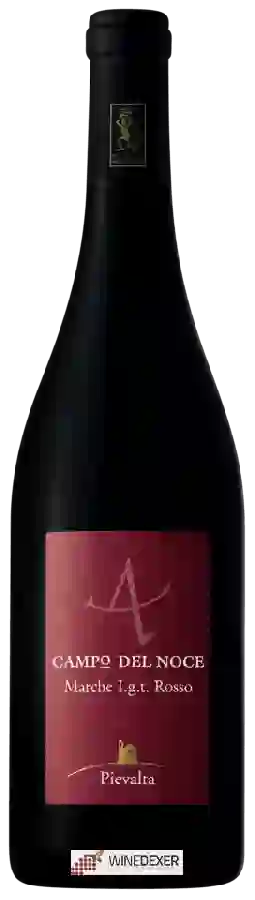
Winery PievaltaCampo del Noce Rosso
 Red wine



In the mouth this red wine is a powerful with a nice balance between acidity and tannins.
This wine generally goes well with poultry, beef or veal.
The Campo del Noce Rosso of the Winery Pievalta is in the top 10 of wines of Marche.

Taste structure of the Campo del Noce Rosso from the Winery Pievalta
Light | Bold | |
Smooth | Tannic | |
Dry | Sweet | |
Soft | Acidic |
In the mouth the Campo del Noce Rosso of Winery Pievalta in the region of Marche is a powerful with a nice balance between acidity and tannins.
Wine flavors and olphactive analysis

Food and wine pairings with Campo del Noce Rosso
Pairings that work perfectly with Campo del Noce Rosso



Original food and wine pairings with Campo del Noce Rosso

The Campo del Noce Rosso of Winery Pievalta matches generally quite well with dishes of beef, pasta or veal such as recipes of beef pot-au-feu, wok of chinese noodles with vegetables or grenadins of veal with ceps.
Details and technical informations about Winery Pievalta's Campo del Noce Rosso.
Discover the grape variety: Arnsburger
Lively and fruity whites with a pale golden colour, a light palate with preserved acidity and signature aromas of citrus (lemon), white flowers, white-fleshed fruits (green apple) and light mineral notes. Close to Riesling without matching its finesse. Grown on small surfaces in Germany and Madeira for dry whites and sparkling base wines. German white variety obtained in 1939 at Geisenheim by Helmut Becker (Riesling × Riesling), late-ripening and productive.
Last vintages of this wine
The best vintages of Campo del Noce Rosso from Winery Pievalta are 2017, 0, 2016
Informations about the Winery Pievalta
The Winery Pievalta is one of of the world's greatest estates. It offers 9 wines for sale in the of Marche to come and discover on site or to buy online.

The wine region of Marche
Italian star of Verdicchio: exceptional age-worthy whites, straight and mineral with signature notes of green almond, lemon, green apple, dry herbs and a slightly bitter finish. Two DOCGs: Castelli di Jesi (coastal, airy) and Matelica (inland, more concentrated). Mediterranean reds: fleshy Montepulciano in Rosso Conero near Ancona, supple Sangiovese. Also fresh Pecorino and Passerina.
The word of the wine: Residual sugars
Sugars not transformed into alcohol and naturally present in the wine. The perception of residual sugars is conditioned by the acidity of the wine. The more acidic the wine is, the less sweet it will seem, given the same amount of sugar.