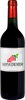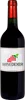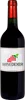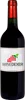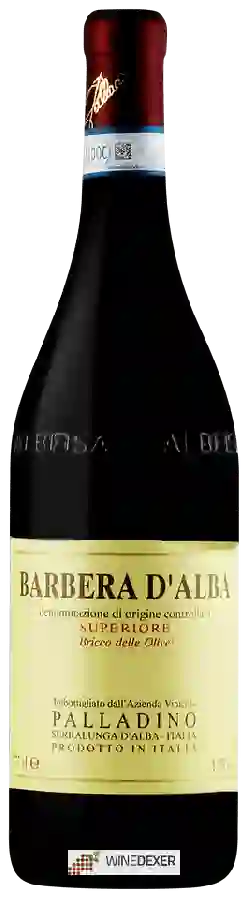
Winery PalladinoBarbera d'Alba Superiore Bricco Delle Olive
 Red wine



In the mouth this red wine is a powerful with a nice freshness.
This wine generally goes well with pork, poultry or veal.
Taste structure of the Barbera d'Alba Superiore Bricco Delle Olive from the Winery Palladino
Light | Bold | |
Smooth | Tannic | |
Dry | Sweet | |
Soft | Acidic |
In the mouth the Barbera d'Alba Superiore Bricco Delle Olive of Winery Palladino in the region of Piedmont is a powerful with a nice freshness.
Wine flavors and olphactive analysis





On the nose the Barbera d'Alba Superiore Bricco Delle Olive of Winery Palladino in the region of Piedmont often reveals types of flavors of non oak, earth or microbio and sometimes also flavors of oak, spices or red fruit.
Food and wine pairings with Barbera d'Alba Superiore Bricco Delle Olive
Pairings that work perfectly with Barbera d'Alba Superiore Bricco Delle Olive



Original food and wine pairings with Barbera d'Alba Superiore Bricco Delle Olive


The Barbera d'Alba Superiore Bricco Delle Olive of Winery Palladino matches generally quite well with dishes of pasta, veal or pork such as recipes of lasagne, chicken supreme with morels or lentils and morteau sausages.
Details and technical informations about Winery Palladino's Barbera d'Alba Superiore Bricco Delle Olive.
Discover the grape variety: Dorona
An autochthonous Italian grape variety that was cultivated for a very long time, particularly in the Venice region, where it almost disappeared. It seems to be known only in this region and therefore completely unknown in all other wine-producing countries. According to recently published A.D.N. analyses, it is the result of a natural intraspecific cross between Garganega and Tuscan malvasia or malvasia del chianti, which explains why it has long been confused with its mother, Garganega.
Last vintages of this wine
The best vintages of Barbera d'Alba Superiore Bricco Delle Olive from Winery Palladino are 2017, 2010, 2012, 2016 and 2015.
Informations about the Winery Palladino
The Winery Palladino is one of of the world's greatest estates. It offers 22 wines for sale in the of Barbera d'Alba to come and discover on site or to buy online.

The wine region of Barbera d'Alba
The wine region of Barbera d'Alba is located in the region of Piémont of Italy. Wineries and vineyards like the Domaine Bospoeper or the Domaine Roberto Voerzio produce mainly wines red and sweet. The most planted grape varieties in the region of Barbera d'Alba are Nebbiolo, they are then used in wines in blends or as a single variety. On the nose of Barbera d'Alba often reveals types of flavors of cream, stone or tree fruit and sometimes also flavors of oil, pomegranate or sage.
The wine region of Piedmont
Piedmont (Piemonte) holds an unrivalled place among the world's finest wine regions. Located in northwestern Italy, it is home to more DOCG wines than any other Italian region, including such well-known and respected names as Barolo, Barbaresco and Barbera d'Asti. Though famous for its Austere, Tannic, Floral">floral reds made from Nebbiolo, Piedmont's biggest success story in the past decade has been Moscato d'Asti, a Sweet, Sparkling white wine. Piedmont Lies, as its name suggests, at the foot of the Western Alps, which encircle its northern and western sides and form its naturally formidable border with Provence, France.
The word of the wine: Garrigue
Notes reminiscent of aromatic Mediterranean herbs such as thyme or rosemary, found in many southern wines.