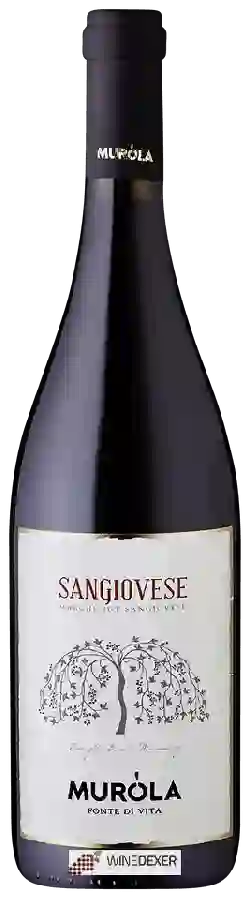
Winery MuròlaSangiovese
 Red wine


In the mouth this red wine is a powerful.
This wine generally goes well with poultry, beef or veal.
Taste structure of the Sangiovese from the Winery Muròla
Light | Bold | |
Smooth | Tannic | |
Dry | Sweet | |
Soft | Acidic |
In the mouth the Sangiovese of Winery Muròla in the region of Marche is a powerful.
Wine flavors and olphactive analysis



On the nose the Sangiovese of Winery Muròla in the region of Marche often reveals types of flavors of earth, red fruit.
Food and wine pairings with Sangiovese
Pairings that work perfectly with Sangiovese



Original food and wine pairings with Sangiovese

The Sangiovese of Winery Muròla matches generally quite well with dishes of beef, pasta or veal such as recipes of sautéed pork with pineapple, pasta with shrimp or osso bucco of veal.
Details and technical informations about Winery Muròla's Sangiovese.
Discover the grape variety: Sangiovese
Originally from Italy, it is the famous Sangiovese of Tuscany producing the famous wines of Brunello de Montalcino and Chianti. This variety is registered in the Official Catalogue of Wine Grape Varieties, list A1. According to recent genetic analysis, it is the result of a natural cross between the almost unknown Calabrese di Montenuovo (mother) and Ciliegiolo (father).
Last vintages of this wine

The best vintages of Sangiovese from Winery Muròla are 2016, 2012, 2015, 2013 and 0.
Informations about the Winery Muròla
The Winery Muròla is one of of the world's greatest estates. It offers 40 wines for sale in the of Marche to come and discover on site or to buy online.

The wine region of Marche
Marche (or Le Marche; pronounced Mar-kay) is a region in eastern CentralItaly. It is most associated with white wines made from Trebbiano and Verdicchio grapes. Marche occupies a roughly triangular area. Its longer sides are formed by the Apennine Mountains to the west and the Adriatic Sea to the east.
The word of the wine: Acidic (flavor)
Acidity is present in all wines, and is essential in white wines. It is due to the presence of different organic acids in the wine, and is expressed in the mouth by a sensation of freshness combined with other elements, such as minerality or a note of bitterness. Moderately present, it brings relief and vivacity to the wine.