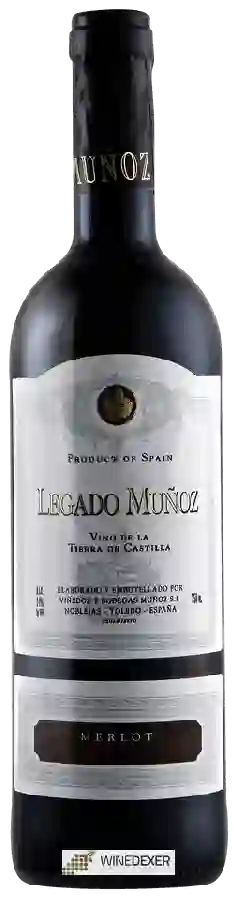
Winery MunozLegado Muñoz Merlot
 Red wine



In the mouth this red wine is a powerful with a lot of tannins present in the mouth.
This wine generally goes well with poultry, beef or veal.

Taste structure of the Legado Muñoz Merlot from the Winery Munoz
Light | Bold | |
Smooth | Tannic | |
Dry | Sweet | |
Soft | Acidic |
In the mouth the Legado Muñoz Merlot of Winery Munoz in the region of Castille is a powerful with a lot of tannins present in the mouth.
Food and wine pairings with Legado Muñoz Merlot
Pairings that work perfectly with Legado Muñoz Merlot



Original food and wine pairings with Legado Muñoz Merlot

The Legado Muñoz Merlot of Winery Munoz matches generally quite well with dishes of beef, pasta or veal such as recipes of beer goulash, meat and goat pie or veal chop normandy style.
Details and technical informations about Winery Munoz's Legado Muñoz Merlot.
Discover the grape variety: Merlot
Round and fleshy reds with a velvety texture, showing aromas of ripe plum, black cherry, cocoa and truffle notes with age. Supple tannins, generous alcohol, indulgent finish. Pillar of Libournais (Pomerol with Pétrus, Saint-Émilion with Cheval Blanc and Ausone) and signature of Super Tuscans, Italian Wales and Washington State. A cross of Cabernet Franc × Magdeleine Noire, France's most planted red variety.
Last vintages of this wine
The best vintages of Legado Muñoz Merlot from Winery Munoz are 2014, 0, 2013, 2011
Informations about the Winery Munoz
The Winery Munoz is one of of the world's great estates. It offers 38 wines for sale in the of Castille to come and discover on site or to buy online.

The wine region of Castille
Cradle of great Castilian reds, high-altitude plateaus (450-1000 m) along the Duero. Tempranillo king (aka Tinta de Toro, Tinto Fino): powerful, concentrated, structured reds with notes of black cherry, plum, leather, tobacco and spice, firm tannins from altitude and cool nights. Stars: Ribera del Duero (Vega Sicilia, Pingus), fleshy Toro, Bierzo (floral, mineral Mencía). Lively, herbaceous Verdejo whites from Rueda.
The word of the wine: Thinning
Also known as green harvesting, the practice of removing excess bunches of grapes from certain vines, usually in July, but sometimes later. This is often necessary, but not always a good thing, as the remaining bunches often gain weight.