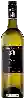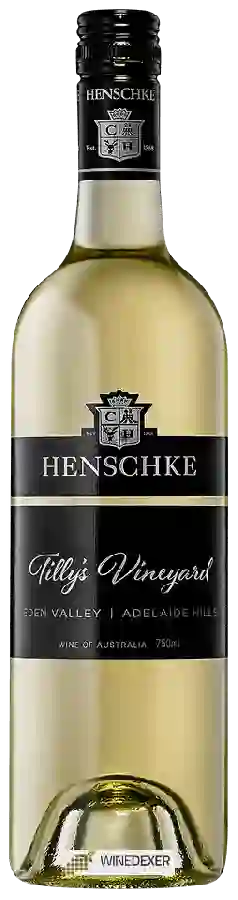
Winery HenschkeTilly's Vineyard
 White wine



This wine generally goes well with poultry, rich fish (salmon, tuna etc) or shellfish.
Wine flavors and olphactive analysis






On the nose the Tilly's Vineyard of Winery Henschke in the region of Australie du Sud often reveals types of flavors of non oak, earth or microbio and sometimes also flavors of vegetal, oak or tree fruit.
Food and wine pairings with Tilly's Vineyard
Pairings that work perfectly with Tilly's Vineyard



Original food and wine pairings with Tilly's Vineyard

The Tilly's Vineyard of Winery Henschke matches generally quite well with dishes of rich fish (salmon, tuna etc), shellfish or sweet desserts such as recipes of papillotes of mackerel, wok of pointed cabbage with shrimps and lemongrass bo bun style or tarte tatin.
Details and technical informations about Winery Henschke's Tilly's Vineyard.
Discover the grape variety: Galotta
Intraspecific cross between ancellotta and gamay à jus blanc obtained in 1981 at the Agroscope Research Station in Pully (Switzerland).
Last vintages of this wine
The best vintages of Tilly's Vineyard from Winery Henschke are 2014, 2018, 2016, 2015 and 2013.
Informations about the Winery Henschke
The Winery Henschke is one of of the world's great estates. It offers 41 wines for sale in the of Australie du Sud to come and discover on site or to buy online.

The wine region of Australie du Sud
SouthAustralia is one of Australia's six states, located (as the name suggests) in the south of the vast island continent. It's the engine room of the Australian wine industry, responsible for about half of the country's total production each year. But there's more to the region than quantity - countless high-quality wines are produced here, most from the region's signature Grape, Shiraz. These include such fine, collectible wines as Penfolds Grange, Henschke Hill of Grace, Torbreck The Laird and d'Arenberg The Dead Arm.
The word of the wine: Presses
The juice that results from pressing the grapes after fermentation. At the end of the maceration, the vats are emptied, the first juice obtained is called the free-run wine and the marc remaining at the bottom of the vat is then pressed to give the press wine. We say more quickly "the presses". Their quality varies according to the vintage and the maceration. A too vigorous extraction releases the tannins of pips and the wine of press can then prove to be very astringent. Often the winemaker raises it separately, deciding later whether or not to incorporate it totally or partially into the grand vin.