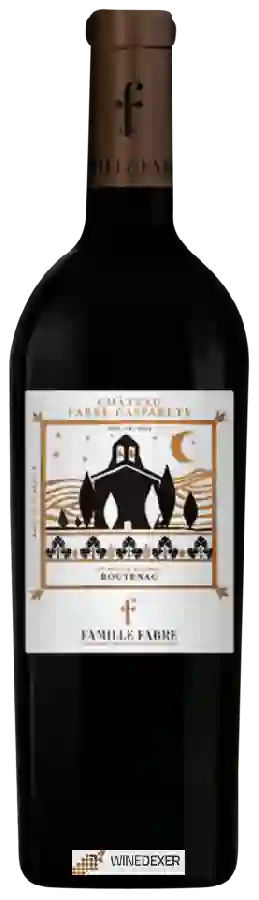
Château Fabre GasparetsBoutenac
 Red wine


In the mouth this red wine is a powerful with a nice balance between acidity and tannins.
This wine generally goes well with beef, veal or pasta.
The Boutenac of the Château Fabre Gasparets is in the top 50 of wines of Corbières Boutenac.

Taste structure of the Boutenac from the Château Fabre Gasparets
Light | Bold | |
Smooth | Tannic | |
Dry | Sweet | |
Soft | Acidic |
In the mouth the Boutenac of Château Fabre Gasparets in the region of Languedoc-Roussillon is a powerful with a nice balance between acidity and tannins.
Wine flavors and olphactive analysis




On the nose the Boutenac of Château Fabre Gasparets in the region of Languedoc-Roussillon often reveals types of flavors of cream, cherry or oaky and sometimes also flavors of blackberry, red fruit or tobacco.
Food and wine pairings with Boutenac
Pairings that work perfectly with Boutenac



Original food and wine pairings with Boutenac
The Boutenac of Château Fabre Gasparets matches generally quite well with dishes of beef, pasta or veal such as recipes of family potluck, pasta with vegetables or veal paupiettes with onions and tomatoes.
Details and technical informations about Château Fabre Gasparets's Boutenac.
Discover the grape variety: Mourvèdre
Powerful, deep reds with firm tannins and dense texture, showing aromas of blackberry, leather, garrigue, black pepper, liquorice and animal notes (game, forest floor) with age. Star of Bandol AOC as a single variety and pillar of Châteauneuf-du-Pape, Gigondas and Costières blends. Also in GSM in Languedoc and Australia. A late-ripening variety of Spanish origin (Mataró/Monastrell).
Last vintages of this wine
The best vintages of Boutenac from Château Fabre Gasparets are 2015, 2016, 2013, 2017 and 2014.
Informations about the Château Fabre Gasparets
The Château Fabre Gasparets is one of of the world's greatest estates. It offers 9 wines for sale in the of Corbières Boutenac to come and discover on site or to buy online.

The wine region of Corbières Boutenac
Languedoc AOP at the heart of Corbières (180 m, stony iron-rich clay-limestone hills, Mediterranean with cers wind): signature Carignan red (30–50%) complemented by Syrah (≤30%), Grenache and Mourvèdre — dark-coloured with ripe black fruits (cherry, blackberry, plum), spices and garrigue, full-bodied with silky tannins and persistent finish. Old-vine Carignan, AOP 2005, finesse and elegance, first cru of Languedoc.
The wine region of Languedoc-Roussillon
Largest single French vineyard, dominated by sunny, generous reds. Spicy Syrah, candied Grenache (ripe fruit, garrigue), structured Carignan, deep Mourvèdre, supple Cinsault. Stars: structured Corbières, Minervois, Faugères, Saint-Chinian; round Côtes-du-Roussillon. Legendary vins doux naturels: Banyuls and Maury (fortified Grenache) with notes of cocoa, fig, prune.
The word of the wine: Pinot meunier
Cultivated in the 19th century in all the northern vineyards, this black grape variety has largely regressed since. Very present in the Marne valley, it constitutes a third of the vineyards in Champagne, alongside pinot noir and chardonnay with which it is often blended. It brings roundness and red and yellow fruit aromas to champagnes. Pinot meunier is also the dominant grape variety in red and rosé wines in the Orleans AOC and the rare Touraine-Noble-Joué, a grey wine. Syn.: meunier.