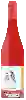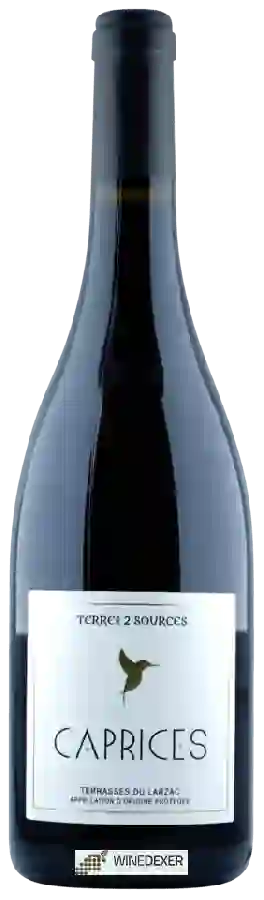
Winery Terre des 2 SourcesCaprices
 Red wine
This wine generally goes well with beef, veal or pasta.
Food and wine pairings with Caprices
Pairings that work perfectly with Caprices



Original food and wine pairings with Caprices
The Caprices of Winery Terre des 2 Sources matches generally quite well with dishes of beef, pasta or veal such as recipes of spaghetti with beef balls, spaghetti bolognese or tête de veau sauce moi.
Details and technical informations about Winery Terre des 2 Sources's Caprices.
Discover the grape variety: Zweigelt
Intraspecific crossing between the saint laurent and the limberger realized in 1922 and in Austria by Fritz Zweigelt (1888/1964) who named it rotburger. Very well known in Austria, it can be found in most Eastern countries, Japan, Germany, Great Britain, the Netherlands, Belgium, Switzerland, Italy, Canada, the United States, etc. In France, it is not very well known and yet this variety has interesting qualities when vinified as a single variety for both red and rosé wines. - Synonyms: rotburger, klosterneuburger, zweigelt blau, blauer-zweigelt in Germany, zweigeltrebe in Austria, Great Britain and the Czech Republic, blauer zwelgetrabe in Hungary, etc. (for all the synonyms of the grape varieties, click here !)
Last vintages of this wine


The best vintages of Caprices from Winery Terre des 2 Sources are 2017, 0
Informations about the Winery Terre des 2 Sources
The Winery Terre des 2 Sources is one of of the world's greatest estates. It offers 27 wines for sale in the of Terrasses du Larzac to come and discover on site or to buy online.

The wine region of Terrasses du Larzac
The wine region of Terrasses du Larzac is located in the region of Languedoc of Languedoc-Roussillon of France. Wineries and vineyards like the Domaine Montcalmès or the Domaine La Pèira en Damaisèla produce mainly wines red, white and pink. The most planted grape varieties in the region of Terrasses du Larzac are Mourvèdre, Cinsaut and Merlot, they are then used in wines in blends or as a single variety. On the nose of Terrasses du Larzac often reveals types of flavors of cherry, graphite or licorice and sometimes also flavors of citrus fruit, blackberry jam or gingerbread.
The wine region of Languedoc-Roussillon
Languedoc (formerly Coteaux du Languedoc) is a key appellation used in the Languedoc-Roussillon wine region of southern France. It covers Dry table wines of all three colors (red, white and rosé) from the entire region, but leaves Sweet and Sparkling wines to other more specialized appellations. About 75% of all Languedoc wines are red, with the remaining 25% split roughly down the middle between whites and rosés. The appellation covers most of the Languedoc region and almost a third of all the vineyards in France.
The word of the wine: Burgundy piece
228-litre barrel.