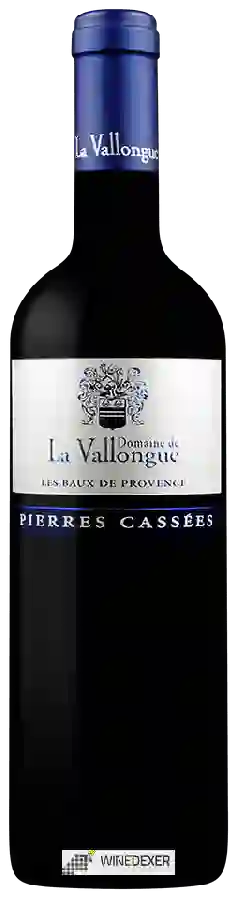
Domaine de la VallonguePierres Cassées Les Baux de Provence
 Red wine


This wine generally goes well with beef, lamb or mature and hard cheese.

Wine flavors and olphactive analysis

On the nose the Pierres Cassées Les Baux de Provence of Domaine de la Vallongue in the region of Provence often reveals types of flavors of black fruit.
Food and wine pairings with Pierres Cassées Les Baux de Provence
Pairings that work perfectly with Pierres Cassées Les Baux de Provence



Original food and wine pairings with Pierres Cassées Les Baux de Provence

The Pierres Cassées Les Baux de Provence of Domaine de la Vallongue matches generally quite well with dishes of beef, lamb or spicy food such as recipes of wild boar stew in burgundy style, gypsy sauce or caramel pork.
Details and technical informations about Domaine de la Vallongue's Pierres Cassées Les Baux de Provence.
Discover the grape variety: Callet
Light, elegant reds with a clear ruby robe, fine tannins and fresh acidity. Delicate aromas of red fruits (cherry, raspberry), Mediterranean herbs (rosemary, thyme), soft spices and floral notes. Airy, refreshing palate, moderate alcohol. Traditional component of Pla i Llevant DO and Binissalem DO on Majorca, often blended with Manto Negro and Fogoneu. Native Spanish variety from the Balearic Islands, emblematic of the archipelago.
Last vintages of this wine

The best vintages of Pierres Cassées Les Baux de Provence from Domaine de la Vallongue are 2014, 2013, 2012, 2011 and 2015.
Informations about the Domaine de la Vallongue
The Domaine de la Vallongue is one of of the world's greatest estates. It offers 16 wines for sale in the of Les Baux-de-Provence to come and discover on site or to buy online.

The wine region of Les Baux-de-Provence
Provençal AOC in the Alpilles massif (7 communes, 277 ha, France's first 100% organic/biodynamic AOC since 2023), stony calcareous soils, sunny Mediterranean climate with Mistral. Signature reds from Grenache, Mourvèdre and Syrah (≥60%): elegant and sun-drenched with black cherry, garrigue, thyme, rosemary, black olive and peppery notes, tannins melted by sun. Fresh, crunchy rosés. Full whites from Clairette, Grenache Blanc, Vermentino and Roussanne.
The wine region of Provence
World capital of dry, refined rosé (~90% of production). Pale rose-petal colour, delicate nose of fresh red fruits (strawberry, raspberry, redcurrant), citrus (pink grapefruit), white flowers and a mineral touch, taut and thirst-quenching palate — the Mediterranean aperitif par excellence. Blends of Grenache, Cinsault, Syrah, Tibouren and Mourvèdre. Fleshy Bandol reds from Mourvèdre (leather, garrigue, age-worthy), straight Cassis whites.
The word of the wine: Oenologist
Specialist in wine-making techniques. It is a profession and not a passion: one can be an oenophile without being an oenologist (and the opposite too!). Formerly attached to the Faculty of Pharmacy, oenology studies have become independent and have their own university course. Learning to make wine requires a good chemical background but also, increasingly, a good knowledge of the plant. Some oenologists work in laboratories (analysis). Others, the consulting oenologists, work directly in the properties.


