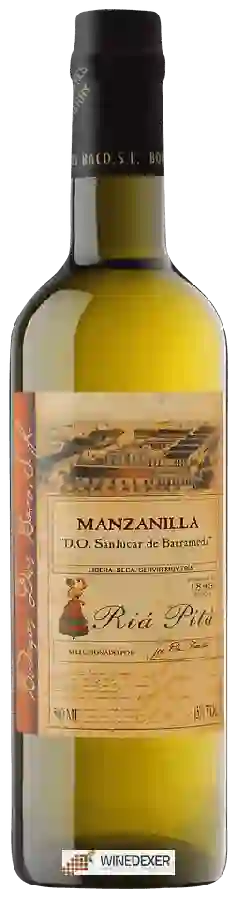
Bodegas Dios BacoRiá Pitá
 Natural sweet wine


In the mouth this natural sweet wine is a powerful with a good balance between acidity and sweetness.
This wine generally goes well with appetizers and snacks, mature and hard cheese or cured meat.

Taste structure of the Riá Pitá from the Bodegas Dios Baco
Light | Bold | |
Dry | Sweet | |
Soft | Acidic |
In the mouth the Riá Pitá of Bodegas Dios Baco in the region of Andalousie is a powerful with a good balance between acidity and sweetness.
Wine flavors and olphactive analysis




On the nose the Riá Pitá of Bodegas Dios Baco in the region of Andalousie often reveals types of flavors of non oak, earth or microbio and sometimes also flavors of vegetal, oak or tree fruit.
Food and wine pairings with Riá Pitá
Pairings that work perfectly with Riá Pitá



Original food and wine pairings with Riá Pitá


The Riá Pitá of Bodegas Dios Baco matches generally quite well with dishes of sweet desserts, mature and hard cheese or appetizers and snacks such as recipes of chocolate mug cake, mushroom, comté and morteau sausage cake or mozzarella sticks.
Details and technical informations about Bodegas Dios Baco's Riá Pitá.
Discover the grape variety: Garonnet
Colourful, structured reds with a sustained purple robe, firm tannins and an ample palate with preserved acidity. Signature aromas of black fruits (blackcurrant, blackberry) and spice. Productive. Grown in small quantities in south-west France for IGPs, blended into modern southern assemblages. A French black grape obtained in 1959 by crossing Morrastel-Bouschet × Cot.
Last vintages of this wine
The best vintages of Riá Pitá from Bodegas Dios Baco are 0
Informations about the Bodegas Dios Baco
The Bodegas Dios Baco is one of of the world's great estates. It offers 15 wines for sale in the of Manzanilla to come and discover on site or to buy online.

The wine region of Manzanilla
Unique DO of Sanlucar de Barrameda at the mouth of the Guadalquivir (Cadiz, Andalusia): signature Palomino Fino as fortified white king under maritime flor veil — distinctly light and delicate signature profile with suggestive saline notes and subtle bitterness, yeasts, breadcrumb, lemon, almond, Mediterranean herbs, chalk and sea spray. Mild humid Atlantic climate developing a thicker flor veil than in Jerez, the most pronounced flor expression among Sherries.
The wine region of Andalousie
Dry, sun-baked southern Spain, world cradle of fortified and oxidative wines. Sherry from Jerez is the signature: Palomino Fino under a veil of flor yields lively, saline Fino with signature notes of almond, yeast, green apple and a sharp iodine edge; more maritime Manzanilla (Sanlúcar); unveiled Oloroso in grand oxidation (walnut, caramel, tobacco). Pedro Ximénez from Montilla-Moriles: intense dark sweet (fig, raisin, coffee, molasses). Also muscat Málaga.
The word of the wine: Oenologist
Specialist in wine-making techniques. It is a profession and not a passion: one can be an oenophile without being an oenologist (and the opposite too!). Formerly attached to the Faculty of Pharmacy, oenology studies have become independent and have their own university course. Learning to make wine requires a good chemical background but also, increasingly, a good knowledge of the plant. Some oenologists work in laboratories (analysis). Others, the consulting oenologists, work directly in the properties.





