The Château Fortia of Châteauneuf-du-Pape of Rhone Valley
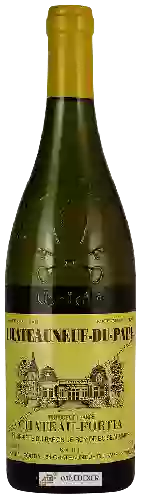
The Château Fortia is one of the best wineries to follow in Châteauneuf-du-Pape.. It offers 8 wines for sale in of Châteauneuf-du-Pape to come and discover on site or to buy online.
Looking for the best Château Fortia wines in Châteauneuf-du-Pape among all the wines in the region? Check out our tops of the best red, white or effervescent Château Fortia wines. Also find some food and wine pairings that may be suitable with the wines from this area. Learn more about the region and the Château Fortia wines with technical and enological descriptions.
How Château Fortia wines pair with each other generally quite well with dishes of pork, rich fish (salmon, tuna etc) or mature and hard cheese such as recipes of home-made white pudding, quick salmon skewers or macaroni and cheese gratin.
On the nose the white wine of Château Fortia. often reveals types of flavors of tropical, citrus or apples and sometimes also flavors of peach, apricot or pear. In the mouth the white wine of Château Fortia. is a powerful with a nice freshness.
The wine region of Châteauneuf-du-Pape is located in the region of Rhône méridional of Rhone Valley of France. Wineries and vineyards like the Domaine Pegau or the Château Rayas produce mainly wines red and white. The most planted grape varieties in the region of Châteauneuf-du-Pape are Mourvèdre, Roussanne and Clairette, they are then used in wines in blends or as a single variety. On the nose of Châteauneuf-du-Pape often reveals types of flavors of iron, chestnut or red licorice and sometimes also flavors of tarragon, pencil shavings or cured meat.
In the mouth of Châteauneuf-du-Pape is a powerful with a nice freshness. We currently count 704 estates and châteaux in the of Châteauneuf-du-Pape, producing 1551 different wines in conventional, organic and biodynamic agriculture. The wines of Châteauneuf-du-Pape go well with generally quite well with dishes of lamb, pork or poultry.
How Château Fortia wines pair with each other generally quite well with dishes of lamb, pork or poultry such as recipes of lamb sweetbreads with white wine and sorrel cream, the real vegetables stuffed in the provençal way or chicken liver cake.
On the nose the red wine of Château Fortia. often reveals types of flavors of smoke, leather or pepper and sometimes also flavors of black fruits, non oak or earth. In the mouth the red wine of Château Fortia. is a powerful with a nice freshness.
Counoise is a black grape variety of Spanish origin. It is widely cultivated in the southern part of France. It is very similar to the aubun, with which it is often confused, and has a white cottony bud. Unlike the aubun, the leaves of this variety do not have teeth in the petiolar sinus. They are thick and large. Its bunches are medium-sized but its berries are large. It is advisable to prune it short so that it is productive. It matures in the second half of the year, but production depends on the vintage. This grape variety appreciates hillside terroirs, which are stony and warm. It fears grey rot without being sensitive to oidium and mildew. Counoise has two approved clones, 508 and 725. The wine obtained from Counoise is not very colourful. It is fine and fruity. Its aromas are diversified with notes of fruit, flowers and spices.
Planning a wine route in the of Châteauneuf-du-Pape? Here are the wineries to visit and the winemakers to meet during your trip in search of wines similar to Château Fortia.
Roussane is a white grape variety, planted on an area of more than 700 ha. Originally from Montélimar, it is also found in Savoie, Languedoc and Roussillon, and grows very well in calcareous, poor, stony soil. It prefers to be pruned short. Roussane is also called fromenteau, barbin or bergeron. The young leaves are bubbled with fine down. When adult, they become thicker. It flowers in June and matures in mid-September. The grapes are cylindrical in shape, the berries are small and turn red when ripe, and the wine produced from pure Roussane is of extraordinary quality. It has a delicate aroma reminiscent of coffee, honeysuckle, iris and peony. The taste of this wine improves with age. It is part of the blend of the appellations Vin-de-Savoie, Côtes-du-Vallée du Rhône or Châteauneuf-du-Pape.