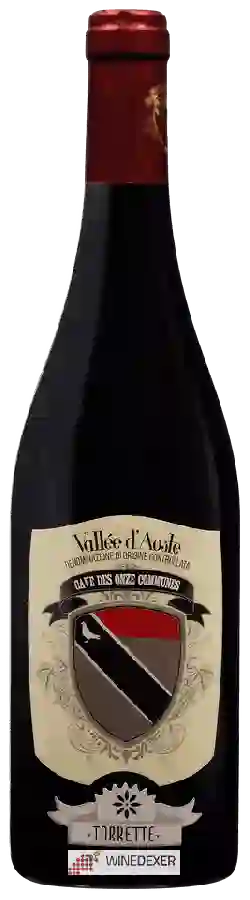
Cave des Onze CommunesTorrette
 Red wine


In the mouth this red wine is a powerful with a lot of tannins present in the mouth.
This wine generally goes well with beef, game (deer, venison) or lamb.
Taste structure of the Torrette from the Cave des Onze Communes
Light | Bold | |
Smooth | Tannic | |
Dry | Sweet | |
Soft | Acidic |
In the mouth the Torrette of Cave des Onze Communes in the region of Valle d'Aosta is a powerful with a lot of tannins present in the mouth.
Wine flavors and olphactive analysis




On the nose the Torrette of Cave des Onze Communes in the region of Valle d'Aosta often reveals types of flavors of earth, microbio or spices and sometimes also flavors of red fruit, black fruit.
Food and wine pairings with Torrette
Pairings that work perfectly with Torrette



Original food and wine pairings with Torrette

The Torrette of Cave des Onze Communes matches generally quite well with dishes of beef, pasta or lamb such as recipes of pasticcio (greece), pasta with zucchini or lamb roast with lavender.
Details and technical informations about Cave des Onze Communes's Torrette.
Discover the grape variety: Landal
Landal noir is a grape variety that originated in France. It is a variety resulting from a cross of the same species (interspecific hybridization). It produces a variety of grape specially used for wine making. It is rare to find this grape to eat on our tables. The Landal noir can be found cultivated in these vineyards: Languedoc & Roussillon, Savoie & Bugey, Rhone Valley.
Last vintages of this wine

The best vintages of Torrette from Cave des Onze Communes are 2016, 2019, 2018, 2017 and 2015.
Informations about the Cave des Onze Communes
The Cave des Onze Communes is one of of the world's greatest estates. It offers 26 wines for sale in the of Valle d'Aosta to come and discover on site or to buy online.

The wine region of Valle d'Aosta
Valle d'Aosta is the smallest and least populated region in Italy, only one-eighth the Size of neighbouring Piedmont. It covers a mountainous area in the far northwest of Italy, where the country's borders meet those of France and Switzerland. Despite the region's small size and low profile, a wide range of red and white wines are produced from a selection of native and introduced Grape varieties. The most important of these is Picotendro, the local form of Nebbiolo.
The word of the wine: Sulphur
An antiseptic and antioxidant substance known since antiquity, probably already used by the Romans. But it was only in modern times that its use was rediscovered. It will allow a better conservation of the wine and thus favour its export. Sulphur also gave the 18th century winegrower the possibility of extending the maceration period without fearing that the wine would turn sour and thus go from dark rosé wines to the red wines of today. Excessive sulphur, on the other hand, kills happiness, paralysing the aromas and causing headaches.