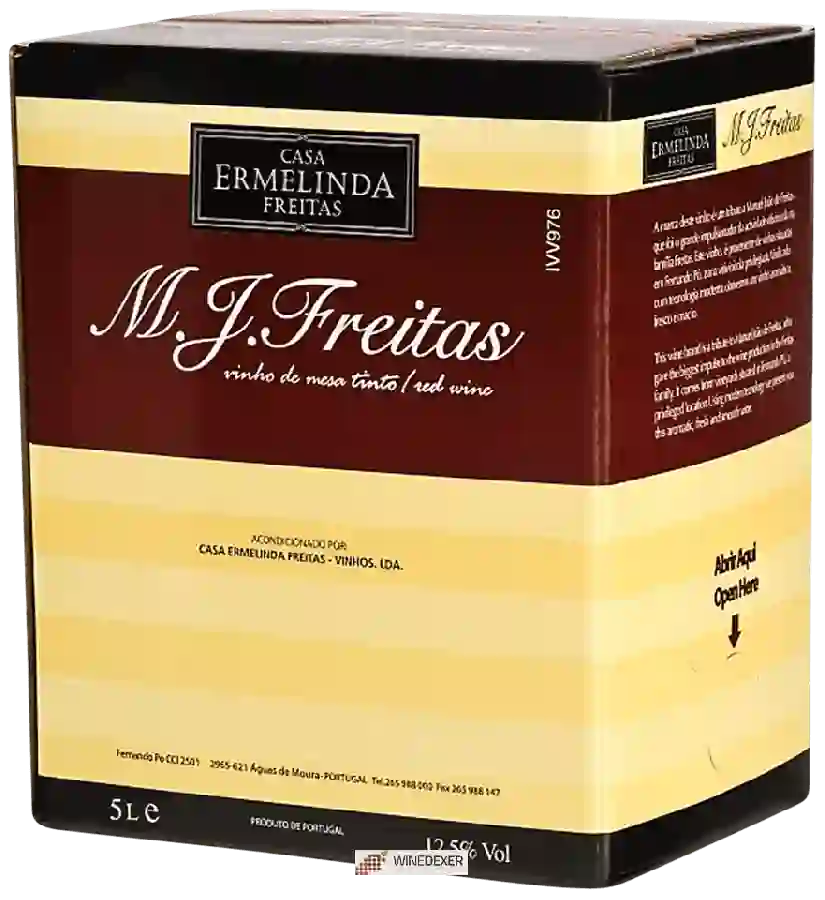
Winery Casa Ermelinda FreitasM. J. Freitas
 Red wine


In the mouth this red wine is a powerful.
This wine generally goes well with poultry, beef or veal.

Taste structure of the M. J. Freitas from the Winery Casa Ermelinda Freitas
Light | Bold | |
Smooth | Tannic | |
Dry | Sweet | |
Soft | Acidic |
In the mouth the M. J. Freitas of Winery Casa Ermelinda Freitas in the region of Península de Setúbal is a powerful.
Food and wine pairings with M. J. Freitas
Pairings that work perfectly with M. J. Freitas



Original food and wine pairings with M. J. Freitas

The M. J. Freitas of Winery Casa Ermelinda Freitas matches generally quite well with dishes of beef, pasta or veal such as recipes of grandma melanie's cassoulet, pasta with crispy parma ham or white wine fondue.
Details and technical informations about Winery Casa Ermelinda Freitas's M. J. Freitas.
Discover the grape variety: Periquita
Supple, fruity reds with an intense ruby color, smooth tannins and a generous palate, offering signature aromas of red fruits (raspberry, strawberry, blackberry), plum, cherry, soft spices and Mediterranean herbaceous notes. An accessible, sunny profile. Essential component of Setúbal Peninsula DOC (where it bears this name), Palmela DOC, Alentejo DOC and Tejo DOC reds. Portuguese synonym for castelão, one of Portugal's most planted indigenous varieties.
Last vintages of this wine

The best vintages of M. J. Freitas from Winery Casa Ermelinda Freitas are 2013, 2011, 2015, 2014 and 2016.
Informations about the Winery Casa Ermelinda Freitas
The Winery Casa Ermelinda Freitas is one of of the world's great estates. It offers 106 wines for sale in the of Palmela to come and discover on site or to buy online.

The wine region of Palmela
DOC of the Setúbal peninsula south of Lisbon, sandy and limestone plains between mountains and Atlantic, warm maritime climate. Signature Castelão as red king (min. 67%, thrives better here than elsewhere in Portugal): fresh and fruity profile with notes of red cherry, raspberry, plum, Mediterranean herbs and a peppery touch, firm but round tannins — with age, complex notes of cedar and tobacco. Aragonez, Trincadeira, Cabernet and Syrah as complements.
The wine region of Península de Setúbal
Portuguese peninsula south of Lisbon between the Tagus and Sado estuaries. World-renowned speciality: Moscatel de Setúbal, a golden fortified sweet wine with signature notes of candied orange, dried apricot, honey, fig, currant and sweet spices, long ageing — the rare Roxo version has more floral notes. Also fruity, supple Castelão reds (64%) (blackberry, plum), perfumed Touriga Nacional. Oceanic climate.
The word of the wine: Nouaison
Phase of the vegetative cycle of the vine following flowering and corresponding to the formation of the grape berry.