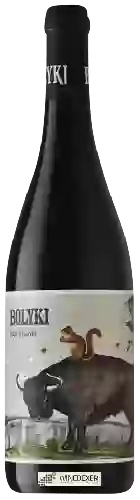
The Winery Bolyki of Eger | Winedexer

The Winery Bolyki is one of the world's great estates. It offers 34 wines for sale in of Eger to come and discover on site or to buy online.
Looking for the best Winery Bolyki wines in Eger among all the wines in the region? Check out our tops of the best red, white or effervescent Winery Bolyki wines. Also find some food and wine pairings that may be suitable with the wines from this area. Learn more about the region and the Winery Bolyki wines with technical and enological descriptions.
How Winery Bolyki wines pair with each other generally quite well with dishes of beef, lamb or pork such as recipes of piglet shoulder with melting baked apples, lamb in a crown with spring vegetables or ham croquette with purée.
On the nose the red wine of Winery Bolyki. often reveals types of flavors of cherry, oaky or smoke and sometimes also flavors of earthy, blackberry or blueberry.
Emblematic Hungarian region in the north, home of the legendary Egri Bikavér ("Bull's Blood"). A blend of fleshy, spicy reds with signature notes of black cherry, ripe plum, paprika, sweet spices and tobacco, round tannins. Mandatory base of Kékfrankos (Blaufränkisch), blended with fruity Kadarka, peppery Cabernet Franc and supple Merlot. Also Egri Csillag in white ("Star of Eger"), fresh and aromatic.
Volcanic rhyolite tuff soils, troglodyte cellars. ~5,400 ha.
How Winery Bolyki wines pair with each other generally quite well with dishes of rich fish (salmon, tuna etc), shellfish or vegetarian such as recipes of codfish portuguese style, my chef's pot or quiche lorraine.
Elegant reds, light in colour with silky tannins, showing strawberry, cherry and raspberry aromas, evolving to forest floor, mushroom and spice with age. Fresh acidity, delicate finish. Star of the Côte d'Or (Romanée-Conti, Chambertin, Volnay), pillar of Champagne (Blanc de Noirs) and signature of Oregon, Central Otago and Sonoma Coast. An early-ripening Burgundian variety, one of the world's greatest.
How Winery Bolyki wines pair with each other generally quite well with dishes of rich fish (salmon, tuna etc), shellfish or vegetarian such as recipes of tuna provencal style, seafood and mushroom quiche or quiche with bacon and gruyère cheese.
On the nose the white wine of Winery Bolyki. often reveals types of flavors of non oak, earth or microbio and sometimes also flavors of vegetal, oak or tree fruit.
Vegetable odour reminiscent of freshly cut grass and considered a defect of the wine.
How Winery Bolyki wines pair with each other generally quite well with dishes of beef or game (deer, venison) such as recipes of tournedos rossini or rabbit with mustard in a casserole.
On the nose the pink wine of Winery Bolyki. often reveals types of flavors of non oak, earth or oak and sometimes also flavors of spices, citrus fruit or red fruit.
Soft, fruity reds with a deep ruby hue, smooth tannins and a straightforward palate featuring signature aromas of red fruits (cherry, blackberry), gentle spices and fresh floral notes. An early-ripening everyday variety. Grown in Austria (Burgenland, Niederösterreich) and Hungary, used for dry reds and everyday blends. Austrian black grape bred in 1923 at Klosterneuburg by Fritz Zweigelt (Portugieser × Blaufränkisch).
How Winery Bolyki wines pair with each other generally quite well with dishes such as recipes .
On the nose the sweet wine of Winery Bolyki. often reveals types of flavors of earth, tree fruit or citrus fruit.
In the major wine regions, the négociant does not simply buy and resell the wines but, from very young wines, carries out all the maturing operations until bottling.
Planning a wine route in the of Eger? Here are the wineries to visit and the winemakers to meet during your trip in search of wines similar to Winery Bolyki.
Supple and fruity reds with a vivid ruby colour, soft tannins and snappy acidity, with aromas of sour cherry, raspberry, red plum and gentle spices. Made as easy-drinking young reds and as more structured, oak-aged cellar wines. The most planted red variety in Austria (Burgenland, Carnuntum, Neusiedlersee), created in 1922 by Friedrich Zweigelt in Klosterneuburg, a cross of saint laurent × blaufränkisch.