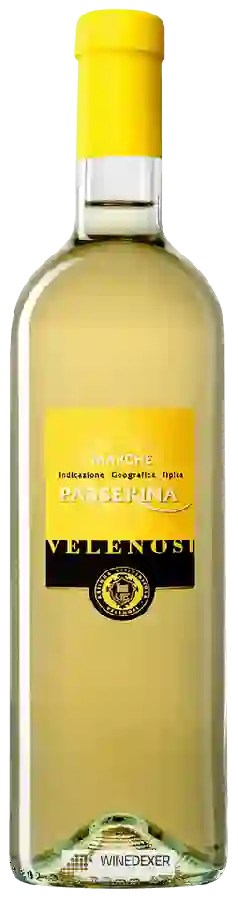
Winery VelenosiMarche Passerina
 White wine



In the mouth this white wine is a powerful with a nice freshness.
This wine generally goes well with lean fish, shellfish or mature and hard cheese.
Taste structure of the Marche Passerina from the Winery Velenosi
Light | Bold | |
Dry | Sweet | |
Soft | Acidic |
In the mouth the Marche Passerina of Winery Velenosi in the region of Marche is a powerful with a nice freshness.
Wine flavors and olphactive analysis

Food and wine pairings with Marche Passerina
Pairings that work perfectly with Marche Passerina



Original food and wine pairings with Marche Passerina


The Marche Passerina of Winery Velenosi matches generally quite well with dishes of pasta, shellfish or mature and hard cheese such as recipes of tuscan linguine, cataplana with seafood or peppers with lentil stuffing.
Details and technical informations about Winery Velenosi's Marche Passerina.
Discover the grape variety: Gravesina
We do not know exactly where this grape variety comes from. It can be found in Austria, Romania, northern Italy, Croatia, Serbia, Hungary, Bulgaria, the Czech Republic, Slovakia, Russia, etc. It is practically unknown in France. In Spain, Borba is said to be identical to the Italian Riesling.
Last vintages of this wine
The best vintages of Marche Passerina from Winery Velenosi are 2015, 2016, 2018, 0 and 2014.
Informations about the Winery Velenosi
The Winery Velenosi is one of of the world's great estates. It offers 79 wines for sale in the of Marche to come and discover on site or to buy online.

The wine region of Marche
Marche (or Le Marche; pronounced Mar-kay) is a region in eastern CentralItaly. It is most associated with white wines made from Trebbiano and Verdicchio grapes. Marche occupies a roughly triangular area. Its longer sides are formed by the Apennine Mountains to the west and the Adriatic Sea to the east.
The word of the wine: Basic wine
Dry, still wine intended for the production of sparkling wines (champagne, crémants, etc.). The basic wines undergo a second fermentation in the bottle for the production of carbon dioxide, and therefore of bubbles.