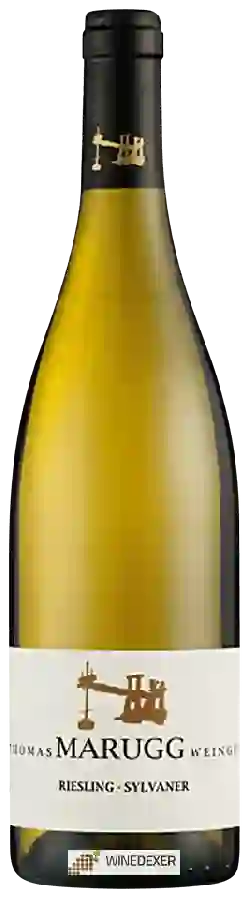
Winery Thomas MaruggRiesling - Sylvaner
 White wine


This wine is a blend of 2 varietals which are the Riesling and the Sylvaner.
This wine generally goes well with pork, vegetarian or poultry.

Food and wine pairings with Riesling - Sylvaner
Pairings that work perfectly with Riesling - Sylvaner



Original food and wine pairings with Riesling - Sylvaner



The Riesling - Sylvaner of Winery Thomas Marugg matches generally quite well with dishes of pork, rich fish (salmon, tuna etc) or spicy food such as recipes of tartiflette, tuna sandwich or express seafood spaghetti.
Details and technical informations about Winery Thomas Marugg's Riesling - Sylvaner.
Discover the grape variety: Riesling
Crystalline, taut whites with vibrant acidity and aromas of citrus, green apple, white flowers, vineyard peach and mineral/petrol notes with age. Made as dry (Trocken, Alsace), off-dry (Kabinett, Spätlese) and sweet (Auslese, Beerenauslese, Trockenbeerenauslese, late harvest). Star of the Moselle, Rheingau, Alsace AOC and Wachau. Also exported to Clare Valley and Finger Lakes.
Last vintages of this wine
The best vintages of Riesling - Sylvaner from Winery Thomas Marugg are 2014, 2018, 2015, 0 and 2019.
Informations about the Winery Thomas Marugg
The Winery Thomas Marugg is one of of the world's greatest estates. It offers 19 wines for sale in the of Graubünden to come and discover on site or to buy online.

The wine region of Graubünden
Wine canton of eastern German-speaking Switzerland (Grisons), 423 ha at the heart of the Bündner Herrschaft (Fläsch, Maienfeld, Malans, Jenins). Signature Pinot Noir (Blauburgunder, >70%): reds among the noblest in Switzerland, fine and silky with notes of cherry, raspberry, undergrowth, sweet spices and a limestone mineral touch, delicate tannins - compared to the great Burgundies. Schistous limestone soils, a climate tempered by the foehn (warmest area of German-speaking Switzerland).
The word of the wine: Free-run wine
The free-run wine is the wine that flows out of the vat by gravity at the time of running off. The marc soaked in wine is then pressed to extract a rich and tannic wine. Free-run wine and press wine are then aged separately and eventually blended by the winemaker in proportions defined according to the type of wine being made.