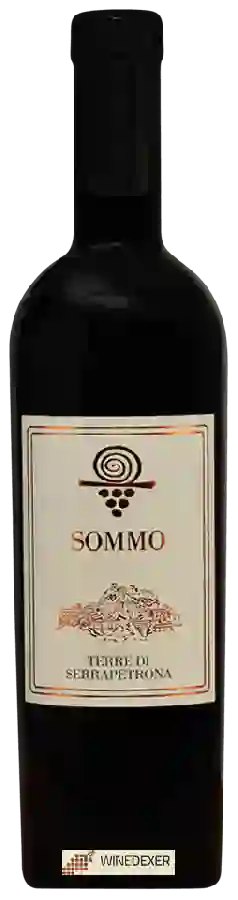
Winery Terre di SerrapetronaSommo
 Red wine


In the mouth this red wine is a powerful with a nice freshness.
This wine generally goes well with poultry, beef or veal.
Taste structure of the Sommo from the Winery Terre di Serrapetrona
Light | Bold | |
Smooth | Tannic | |
Dry | Sweet | |
Soft | Acidic |
In the mouth the Sommo of Winery Terre di Serrapetrona in the region of Marche is a powerful with a nice freshness.
Wine flavors and olphactive analysis

On the nose the Sommo of Winery Terre di Serrapetrona in the region of Marche often reveals types of flavors of oak.
Food and wine pairings with Sommo
Pairings that work perfectly with Sommo



Original food and wine pairings with Sommo

The Sommo of Winery Terre di Serrapetrona matches generally quite well with dishes of beef, pasta or veal such as recipes of greek moussaka, pasta with tuna or simple and fragrant roast veal.
Details and technical informations about Winery Terre di Serrapetrona's Sommo.
Discover the grape variety: Salagnin
Discovered in the 1870s by Mr. Robin, who lived in the Drôme at the time in Lapeyrouse-Mornay, this ancient grape variety is believed to have originated in the north of Isère. It can also be found in Switzerland. According to Thierry Lacombe (I.N.R.A./Montpellier), it is the result of a natural intraspecific crossing between Tressot Noir and Mondeuse Blanche. It should be noted in passing that, on the one hand, it has exactly the same parents as the mondeuse noire, that on the other hand, it is the mother of the diolinoir and, finally, is related to the servanin. Robin noir is not widely propagated today because it is not well known, although it is listed in the Official Catalogue of Wine Grape Varieties, list A1.
Last vintages of this wine

The best vintages of Sommo from Winery Terre di Serrapetrona are 2012, 0, 2011, 2009 and 2008.
Informations about the Winery Terre di Serrapetrona
The Winery Terre di Serrapetrona is one of of the world's greatest estates. It offers 10 wines for sale in the of Marche to come and discover on site or to buy online.

The wine region of Marche
Marche (or Le Marche; pronounced Mar-kay) is a region in eastern CentralItaly. It is most associated with white wines made from Trebbiano and Verdicchio grapes. Marche occupies a roughly triangular area. Its longer sides are formed by the Apennine Mountains to the west and the Adriatic Sea to the east.
The word of the wine: Chai
Place where the wine-making process takes place.