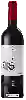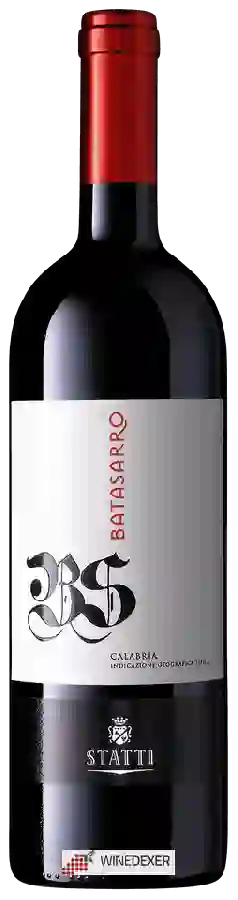
Winery StattiBatasarro
 Red wine



This wine is composed of 100% of the grape variety Gaglioppo.
In the mouth this red wine is a powerful.
This wine generally goes well with beef, lamb or pasta.

Taste structure of the Batasarro from the Winery Statti
Light | Bold | |
Smooth | Tannic | |
Dry | Sweet | |
Soft | Acidic |
In the mouth the Batasarro of Winery Statti in the region of Calabria is a powerful.
Food and wine pairings with Batasarro
Pairings that work perfectly with Batasarro



Original food and wine pairings with Batasarro
The Batasarro of Winery Statti matches generally quite well with dishes of beef, pasta or lamb such as recipes of beef mironton, salmon lasagna or pizza queen with merguez.
Details and technical informations about Winery Statti's Batasarro.
Discover the grape variety: Gaglioppo
Structured, warm reds with a ruby robe evolving towards garnet, firm tannins and moderate acidity, with aromas of black cherry preserve, plum, fig, Mediterranean herbs (oregano, rosemary), spice, leather and balsamic notes. Ample palate, good ageing. Absolute star of Cirò DOC on the Ionian coast of Calabria (one of Europe's oldest vineyards, celebrated since Antiquity). Autochthonous Calabrian variety, a natural descendant of Sangiovese × Mantonico Bianco.
Last vintages of this wine
The best vintages of Batasarro from Winery Statti are 2009, 2012, 0
Informations about the Winery Statti
The Winery Statti is one of of the world's great estates. It offers 24 wines for sale in the of Calabria to come and discover on site or to buy online.

The wine region of Calabria
Italy's far south between the Ionian and Tyrrhenian seas, a millennia-old tradition (Greek "Oenotria"). Emblematic Gaglioppo (the "black prince"): sun-drenched reds with signature notes of black cherry, candied plum, garrigue, tobacco, spice and balsamic notes, firm tannins — peaking at Ciro DOC on the Ionian coast. Also fleshy Magliocco, dense Nerello, Greco Bianco in a fresh, almondy white, ample Mantonico. Hot Mediterranean climate, volcanic and clay-sandy soils.
The word of the wine: Bleeding
Old practice for red wines. As soon as the vat is filled with grapes, the tap is opened. A sweet but clear juice escapes from the vat (it can also be used to make rosé). The colour and density of the juice is enhanced, but it should not be overdone. Rarely more than 10% of the volume of a vat, otherwise you risk losing fruit and bringing in bitterness.