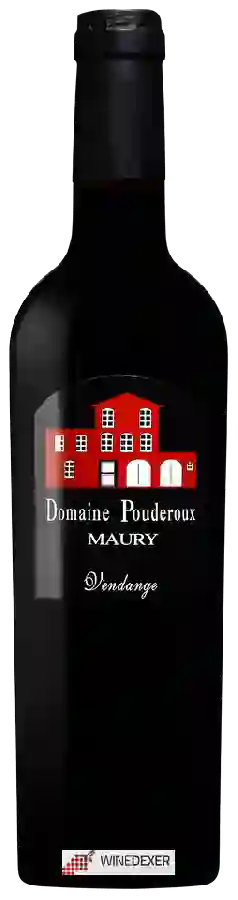
Winery PouderouxMaury Vendange
 Natural sweet wine


This wine generally goes well with beef and mature and hard cheese.
Wine flavors and olphactive analysis





On the nose the Maury Vendange of Winery Pouderoux in the region of Languedoc-Roussillon often reveals types of flavors of cherry, oaky or blackberry and sometimes also flavors of blueberry, red fruit or vanilla.
Food and wine pairings with Maury Vendange
Pairings that work perfectly with Maury Vendange


Original food and wine pairings with Maury Vendange
The Maury Vendange of Winery Pouderoux matches generally quite well with dishes of beef or mature and hard cheese such as recipes of navarin of lamb or country-style sausage.
Details and technical informations about Winery Pouderoux's Maury Vendange.
Discover the grape variety: Colombaud
The colombaud grape variety is equally appreciated as a white table grape and as a wine grape. Originally from Provence, it is practically no longer found in the vineyards. It is known under several other names, including poupousaoumo, courambaou and bouteillan. An amber veil covers them on the sides most exposed to the sun. The thin, crumbly greenish skin protects an ellipsoidal or spherical pulp, juicy and firm in consistency. The pulp has a simple, pleasant and slightly spicy taste. The berries are gathered in bunches carried by strong peduncles. The grapes are of medium length, compact and cylindrical-conical in shape, often with fins, and are harvested at the third medium period, as the grapevine buds late. Short pruning is best suited to this semi-erect plant, which likes exposed, warm soil.
Last vintages of this wine

The best vintages of Maury Vendange from Winery Pouderoux are 2010, 2016, 2011, 2018 and 2012.
Informations about the Winery Pouderoux
The Winery Pouderoux is one of of the world's greatest estates. It offers 22 wines for sale in the of Maury to come and discover on site or to buy online.

The wine region of Maury
Maury is a town in the northern Roussillon region of southern France. Its name is best known as an appellation for the natural Sweet wines produced around the town, although in 2011 the separate AOC Maury Sec came into effect for Dry red wines, due to the recognition that a local wine industry based entirely on fortified wine was too narrowly focused. The natural sweet wines of Maury are mainly produced from the Grenache grapes (Grenache Noir, Grenache Blanc and Grenache Gris). They are produced in a style very similar to the sweet wines of Banyuls, 35 miles (57km) to the southeast, which also use Grenache.
The wine region of Languedoc-Roussillon
Languedoc (formerly Coteaux du Languedoc) is a key appellation used in the Languedoc-Roussillon wine region of southern France. It covers Dry table wines of all three colors (red, white and rosé) from the entire region, but leaves Sweet and Sparkling wines to other more specialized appellations. About 75% of all Languedoc wines are red, with the remaining 25% split roughly down the middle between whites and rosés. The appellation covers most of the Languedoc region and almost a third of all the vineyards in France.
The word of the wine: Muscat blanc à petits grains
A white grape variety cultivated since antiquity on the shores of the Mediterranean, it is considered the noblest of the muscats. It is mainly used to make sweet wines, often from mutage. In France, it is the sole variety used in many natural sweet wines: muscat-de-frontignan, muscat-de-mireval, muscat-de-lunel, muscat-de-saint-jean-de-minervois, muscat-de-beaumes-de-venise, muscat-du-cap-corse. Combined with Muscat d'Alexandrie, it gives Muscat-de-Rivesaltes. It is also used to make sparkling white wines (clairette-de-die; moscato d'asti and asti spumante in Italy) and dry wines (alsace-muscat). Powerfully aromatic and complex, its wines evoke fresh grapes, roses, exotic fruits, citrus fruits and spices.