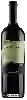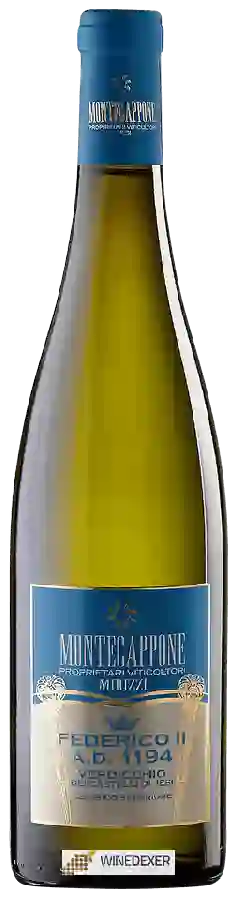
Winery MontecapponeFederico II A.D. 1194 Verdicchio dei Castelli di Jesi Classico Superiore
 White wine



In the mouth this white wine is a with a nice freshness.
This wine generally goes well with vegetarian, appetizers and snacks or lean fish.
Taste structure of the Federico II A.D. 1194 Verdicchio dei Castelli di Jesi Classico Superiore from the Winery Montecappone
Light | Bold | |
Dry | Sweet | |
Soft | Acidic |
In the mouth the Federico II A.D. 1194 Verdicchio dei Castelli di Jesi Classico Superiore of Winery Montecappone in the region of Marche is a with a nice freshness.
Wine flavors and olphactive analysis

On the nose the Federico II A.D. 1194 Verdicchio dei Castelli di Jesi Classico Superiore of Winery Montecappone in the region of Marche often reveals types of flavors of earth.
Food and wine pairings with Federico II A.D. 1194 Verdicchio dei Castelli di Jesi Classico Superiore
Pairings that work perfectly with Federico II A.D. 1194 Verdicchio dei Castelli di Jesi Classico Superiore



Original food and wine pairings with Federico II A.D. 1194 Verdicchio dei Castelli di Jesi Classico Superiore


The Federico II A.D. 1194 Verdicchio dei Castelli di Jesi Classico Superiore of Winery Montecappone matches generally quite well with dishes of vegetarian, pasta or appetizers and snacks such as recipes of quiche with leeks and fresh salmon from flo, pasta with lemon and comté cheese or boquerones anchovies in vinegar.
Details and technical informations about Winery Montecappone's Federico II A.D. 1194 Verdicchio dei Castelli di Jesi Classico Superiore.
Discover the grape variety: Verdicchio
This grape variety was known for a long time in the central region of Italy and is now cultivated in almost all the wine-producing regions of this country. Under the name of peverella, it can still be found in Brazil, where it has occupied large areas for a long time. In France, it is almost unknown. It would seem that it has many relatives, in particular with varieties of Italian origin, known or little known, without us being able to quote them with certainty because the doubt still remains, to be followed! The pink verdicchio exists but is not related to any of them.
Last vintages of this wine
The best vintages of Federico II A.D. 1194 Verdicchio dei Castelli di Jesi Classico Superiore from Winery Montecappone are 2018, 2017, 2016, 0 and 2015.
Informations about the Winery Montecappone
The Winery Montecappone is one of of the world's greatest estates. It offers 31 wines for sale in the of Verdicchio dei Castelli di Jesi to come and discover on site or to buy online.

The wine region of Verdicchio dei Castelli di Jesi
The wine region of Verdicchio dei Castelli di Jesi is located in the region of Marches of Italy. Wineries and vineyards like the Domaine Fattoria San Lorenzo or the Domaine Azienda Santa Barbara - Stefano Antonucci produce mainly wines white, sparkling and sweet. The most planted grape varieties in the region of Verdicchio dei Castelli di Jesi are Chardonnay, Cortese and Pecorino, they are then used in wines in blends or as a single variety. On the nose of Verdicchio dei Castelli di Jesi often reveals types of flavors of citrus, nectarine or chalk and sometimes also flavors of cheese, raisin or plum.
The wine region of Marche
Marche (or Le Marche; pronounced Mar-kay) is a region in eastern CentralItaly. It is most associated with white wines made from Trebbiano and Verdicchio grapes. Marche occupies a roughly triangular area. Its longer sides are formed by the Apennine Mountains to the west and the Adriatic Sea to the east.
The word of the wine: Tanin
A natural compound contained in the skin of the grape, the seed or the woody part of the bunch, the stalk. The maceration of red wines allows the extraction of tannins, which give the texture, the solidity and also the mellowness when the tannins are "ripe". The winemaker seeks above all to extract the tannins from the skin, the ripest and most noble. The tannins of the seed or stalk, which are "greener", especially in average years, give the wine hardness and astringency. The wines of Bordeaux (based on Cabernet and Merlot) are full of tannins, those of Burgundy much less so, with Pinot Noir containing little.