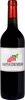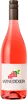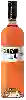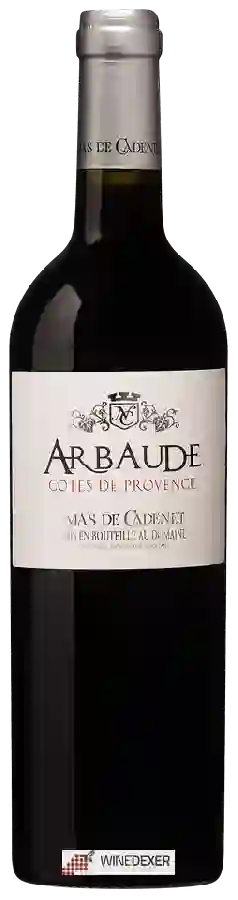
Winery Mas de CadenetArbaude Rouge
 Red wine



This wine generally goes well with beef, lamb or mature and hard cheese.
Wine flavors and olphactive analysis

On the nose the Arbaude Rouge of Winery Mas de Cadenet in the region of Provence often reveals types of flavors of raspberry, tree fruit or citrus fruit and sometimes also flavors of red fruit.
Food and wine pairings with Arbaude Rouge
Pairings that work perfectly with Arbaude Rouge



Original food and wine pairings with Arbaude Rouge

The Arbaude Rouge of Winery Mas de Cadenet matches generally quite well with dishes of beef, lamb or spicy food such as recipes of american style beef marinade, rack of lamb in a salt crust or chili con carne.
Details and technical informations about Winery Mas de Cadenet's Arbaude Rouge.
Discover the grape variety: Prior
Interspecific cross between Freiburg 4-61 (23-416 Joannès-Seyve x pinot noir) and Bronner made in 1987 by Norbert Becker of the Freiburg Research Institute in Germany. It has the particularity of having only one gene for resistance to mildew and powdery mildew. It can be found in Germany, but also in Switzerland, Belgium, ... and in France.
Last vintages of this wine
The best vintages of Arbaude Rouge from Winery Mas de Cadenet are 2015, 2016, 2014, 2012 and 2017.
Informations about the Winery Mas de Cadenet
The Winery Mas de Cadenet is one of of the world's greatest estates. It offers 16 wines for sale in the of Côtes de Provence to come and discover on site or to buy online.

The wine region of Côtes de Provence
World reference for pale, elegant rosé: salmon to onion-skin hue, notes of strawberry, pink grapefruit, white peach and flowers, fresh, dry, mineral palate, taut finish. 90% of output, the Provençal signature. Grenache, Cinsault, Syrah and native Tibouren in the blend. A few fleshy Mediterranean reds (Mourvèdre, Syrah) and saline Vermentino whites.
The wine region of Provence
World capital of dry, refined rosé (~90% of production). Pale rose-petal colour, delicate nose of fresh red fruits (strawberry, raspberry, redcurrant), citrus (pink grapefruit), white flowers and a mineral touch, taut and thirst-quenching palate — the Mediterranean aperitif par excellence. Blends of Grenache, Cinsault, Syrah, Tibouren and Mourvèdre. Fleshy Bandol reds from Mourvèdre (leather, garrigue, age-worthy), straight Cassis whites.
The word of the wine: Muscat blanc à petits grains
A white grape variety cultivated since antiquity on the shores of the Mediterranean, it is considered the noblest of the muscats. It is mainly used to make sweet wines, often from mutage. In France, it is the sole variety used in many natural sweet wines: muscat-de-frontignan, muscat-de-mireval, muscat-de-lunel, muscat-de-saint-jean-de-minervois, muscat-de-beaumes-de-venise, muscat-du-cap-corse. Combined with Muscat d'Alexandrie, it gives Muscat-de-Rivesaltes. It is also used to make sparkling white wines (clairette-de-die; moscato d'asti and asti spumante in Italy) and dry wines (alsace-muscat). Powerfully aromatic and complex, its wines evoke fresh grapes, roses, exotic fruits, citrus fruits and spices.