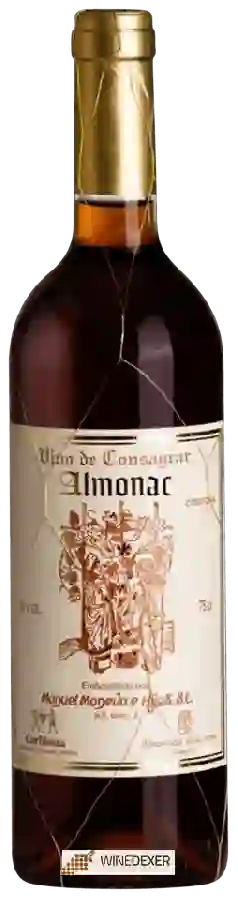
Winery Manuel Moneva e HijosAlmonac Vino de Consagrar
 Red wine
In the mouth this red wine is a powerful.
This wine generally goes well with poultry, beef or veal.

Taste structure of the Almonac Vino de Consagrar from the Winery Manuel Moneva e Hijos
Light | Bold | |
Smooth | Tannic | |
Dry | Sweet | |
Soft | Acidic |
In the mouth the Almonac Vino de Consagrar of Winery Manuel Moneva e Hijos in the region of Aragon is a powerful.
Food and wine pairings with Almonac Vino de Consagrar
Pairings that work perfectly with Almonac Vino de Consagrar



Original food and wine pairings with Almonac Vino de Consagrar

The Almonac Vino de Consagrar of Winery Manuel Moneva e Hijos matches generally quite well with dishes of beef, pasta or veal such as recipes of millet with gruyere cheese, rigatoni with courgettes and tomatoes or veal tagine with preserved lemons and saffron.
Details and technical informations about Winery Manuel Moneva e Hijos's Almonac Vino de Consagrar.
Discover the grape variety: Savagnin
Vivid, structured whites with a golden robe, taut mouthfeel and sharp acidity, with aromas of apple, citrus, green walnut, curry, spices and intense oxidative notes (vin jaune aged under a yeast veil) evoking walnut, roasted almond and the distinctive "goût de jaune". The absolute star of Château-Chalon AOC, Arbois AOC, l'Étoile AOC and Côtes du Jura AOC. A very ancient Jurassian autochthon, probable ancestor of many European varieties.
Informations about the Winery Manuel Moneva e Hijos
The Winery Manuel Moneva e Hijos is one of of the world's greatest estates. It offers 9 wines for sale in the of Cariñena to come and discover on site or to buy online.

The wine region of Cariñena
Historic Aragón (DO since 1932), birthplace of Carignan (Cariñena here). Yet Garnacha dominates: fleshy, sun-soaked reds with signature notes of candied red fruit (cherry, raspberry), spices, pepper, garrigue and balsamic notes, round tannins and opulence. Many old vines. Also dense, tannic Cariñena (Mazuelo), supple Tempranillo.
The wine region of Aragon
Autonomous community of northeast Spain, historic kingdom of Iberian red Grenache (~75%). Signature Garnacha: generous and sun-drenched with signature ripe cherry, crushed strawberry, garrigue, kirsch, sweet spice and a balsamic touch, round tannins and a warm, alcoholic palate. 4 major DOs: Cariñena the largest (old vines), Calatayud high-altitude, Campo de Borja and Somontano at the Pyrenean foothills. Fresh Macabeo and Garnacha blanca whites.
The word of the wine: Maceration
Prolonged contact and exchange between the juice and the grape solids, especially the skin. Not to be confused with the time of fermentation, which follows maceration. The juice becomes loaded with colouring matter and tannins, and acquires aromas. For a rosé, the maceration is short so that the colour does not "rise" too much. For white wines too, a "pellicular maceration" can be practised, which allows the wine to acquire more fat.








