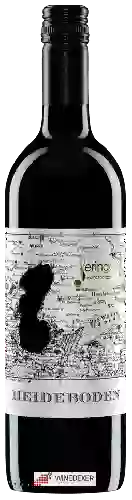
The Winery Keringer of Neusiedlersee of Weinland

The Winery Keringer is one of the largest wineries in the world. It offers 32 wines for sale in of Neusiedlersee to come and discover on site or to buy online.
Looking for the best Winery Keringer wines in Neusiedlersee among all the wines in the region? Check out our tops of the best red, white or effervescent Winery Keringer wines. Also find some food and wine pairings that may be suitable with the wines from this area. Learn more about the region and the Winery Keringer wines with technical and enological descriptions.
How Winery Keringer wines pair with each other generally quite well with dishes of lamb, pork or rich fish (salmon, tuna etc) such as recipes of marinated lamb chops, country-style snow peas or baked sea bream.
On the nose the red wine of Winery Keringer. often reveals types of flavors of oaky, smoke or tobacco and sometimes also flavors of vanilla, non oak or earth. In the mouth the red wine of Winery Keringer. is a powerful with a nice balance between acidity and tannins.
The wine region of Neusiedlersee is located in the region of Burgenland of Weinland of Austria. We currently count 178 estates and châteaux in the of Neusiedlersee, producing 637 different wines in conventional, organic and biodynamic agriculture. The wines of Neusiedlersee go well with generally quite well with dishes .
How Winery Keringer wines pair with each other generally quite well with dishes of pork, rich fish (salmon, tuna etc) or vegetarian such as recipes of texas style ribs / loin ribs, papillotes of simple salmon steaks or leek, goat cheese and bacon quiche.
On the nose the white wine of Winery Keringer. often reveals types of flavors of earth, microbio or tree fruit and sometimes also flavors of oak. In the mouth the white wine of Winery Keringer. is a powerful with a nice freshness.
How Winery Keringer wines pair with each other generally quite well with dishes of lamb, veal or pork such as recipes of saddle of lamb stuffed with chicken breast and basil, pork cheeks with cider and honey or cassoulet.
Champagne term for a merchant who buys grapes to make a Champagne wine himself.
How Winery Keringer wines pair with each other generally quite well with dishes of pork, vegetarian or poultry such as recipes of white cabbage with bacon, vegan leek and tofu quiche or roast chicken and potatoes.
Muscat Ottonel has the character of a grape variety with a distant lineage. It was first obtained in 1839 and continues to be planted in nearly 2,000 hectares of vineyards around the world. It shows good vigour and promises satisfactory production, of the order of 6 kilos per vine. The bunches, which are rather loose, are quite large, bearing berries with a strong character. A pleasantly musky flavour and a lot of juice characterize the pulp, protected by a medium skin. The bluish-black skin contributes to the exceptional beauty of the vineyards at harvest time. The size of the ellipsoidal berries is another argument in favor of Muscat Ottonel, which is also known as Muscat Ottone or Muscadet Ottonel. Resin, toast, honey and wild flowers are all present in the wines made from this variety. If the foliage, which turns yellow in autumn, is one of its charms, remember to protect the fruit from grey rot and coulure.
How Winery Keringer wines pair with each other generally quite well with dishes of lamb, pork or rich fish (salmon, tuna etc) such as recipes of dad's lamb mouse, endives with ham (improved) or steamed ginger fish (china).
Between Épernay and Reims, a large limestone massif with varied soils and exposure where pinot noir reigns supreme. Ambonnay, Bouzy, Verzenay, Verzy, etc., are equivalent to the Burgundian Gevrey-Chambertin and Vosne-Romanée. There are also great Chardonnays, which are rarer (Mailly, Marmery, Trépail, Villers).
Planning a wine route in the of Neusiedlersee? Here are the wineries to visit and the winemakers to meet during your trip in search of wines similar to Winery Keringer.
Intraspecific crossing between the saint laurent and the limberger realized in 1922 and in Austria by Fritz Zweigelt (1888/1964) who named it rotburger. Very well known in Austria, it can be found in most Eastern countries, Japan, Germany, Great Britain, the Netherlands, Belgium, Switzerland, Italy, Canada, the United States, etc. In France, it is not very well known and yet this variety has interesting qualities when vinified as a single variety for both red and rosé wines. - Synonyms: rotburger, klosterneuburger, zweigelt blau, blauer-zweigelt in Germany, zweigeltrebe in Austria, Great Britain and the Czech Republic, blauer zwelgetrabe in Hungary, etc. (for all the synonyms of the grape varieties, click here !)