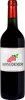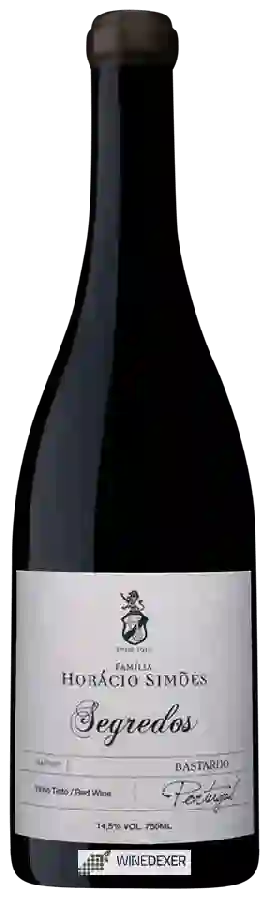
Winery Horácio SimõesSegredos
 Red wine


In the mouth this red wine is a powerful with a nice balance between acidity and tannins.
This wine generally goes well with poultry, beef or veal.
The Segredos of the Winery Horácio Simões is in the top 90 of wines of Península de Setúbal.
Taste structure of the Segredos from the Winery Horácio Simões
Light | Bold | |
Smooth | Tannic | |
Dry | Sweet | |
Soft | Acidic |
In the mouth the Segredos of Winery Horácio Simões in the region of Península de Setúbal is a powerful with a nice balance between acidity and tannins.
Wine flavors and olphactive analysis



On the nose the Segredos of Winery Horácio Simões in the region of Península de Setúbal often reveals types of flavors of spices.
Food and wine pairings with Segredos
Pairings that work perfectly with Segredos



Original food and wine pairings with Segredos

The Segredos of Winery Horácio Simões matches generally quite well with dishes of beef, pasta or veal such as recipes of cataplana with seafood, pasta with walnuts and treviso red salad or roast veal with chanterelles and cream.
Details and technical informations about Winery Horácio Simões's Segredos.
Discover the grape variety: Suffolk red
Interspecific crossing between the fredonia or early concord and the black monukka - the latter also being called russian seedless or black kischmish - obtained in 1935 by John Einset (1915/1981) at the Agricultural Experimental Station of the State of New-York (United States) ... practically unknown in France except for amateur gardeners, registered however in the Official Catalogue of the varieties of grapevine of table A2 list. Note that it has concord and isabelle as parents.
Last vintages of this wine
The best vintages of Segredos from Winery Horácio Simões are 2017, 2016, 2015
Informations about the Winery Horácio Simões
The Winery Horácio Simões is one of of the world's great estates. It offers 30 wines for sale in the of Península de Setúbal to come and discover on site or to buy online.

The wine region of Península de Setúbal
Setúbal Peninsula (also known as Península de Setúbal) is the Portuguese wine region immediately southeast of Lisbon, across the Tejo estuary. The Terroir in the area ranges from sandy coastal plains to the craggy, limestone-rich Serra Arribida hills. The area is known for its Dry red wines made from Castelão, and for its fortified wines and Sweet Moscatel de Setúbal. The wines produced here are made under three titles: two DOCs, Palmela and Setúbal, and one IGP.
The word of the wine: Racé
Character of a great wine remarkable for its elegance and finesse.