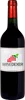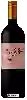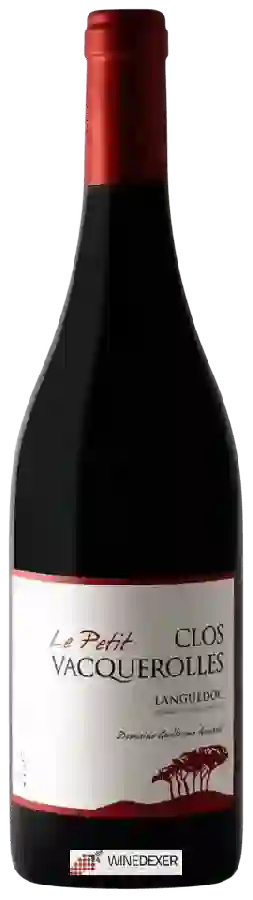
Domaine Guillaume ArmandLe Petit Clos de Vacquerolles
 Red wine



In the mouth this red wine is a powerful with a nice balance between acidity and tannins.
This wine generally goes well with beef, veal or pasta.

Taste structure of the Le Petit Clos de Vacquerolles from the Domaine Guillaume Armand
Light | Bold | |
Smooth | Tannic | |
Dry | Sweet | |
Soft | Acidic |
In the mouth the Le Petit Clos de Vacquerolles of Domaine Guillaume Armand in the region of Languedoc-Roussillon is a powerful with a nice balance between acidity and tannins.
Food and wine pairings with Le Petit Clos de Vacquerolles
Pairings that work perfectly with Le Petit Clos de Vacquerolles



Original food and wine pairings with Le Petit Clos de Vacquerolles
The Le Petit Clos de Vacquerolles of Domaine Guillaume Armand matches generally quite well with dishes of beef, pasta or veal such as recipes of pot-au-feu, chinese noodles with vegetables and spices or pork cheeks with cider and honey.
Details and technical informations about Domaine Guillaume Armand's Le Petit Clos de Vacquerolles.
Discover the grape variety: Perera
Lively and fruity dry whites with a pale golden robe, a supple palate with moderate acidity, showing signature aromas of white-fleshed fruits (pear, apple), white flowers and Venetian herbaceous notes. Also as taut and refreshing Charmat-method sparkling wines. Traditional component of Prosecco DOC and Conegliano Valdobbiadene Prosecco Superiore DOCG alongside Glera. Native white Italian grape from Veneto, grown in the province of Treviso.
Last vintages of this wine
The best vintages of Le Petit Clos de Vacquerolles from Domaine Guillaume Armand are 2018, 2017
Informations about the Domaine Guillaume Armand
The Domaine Guillaume Armand is one of of the world's greatest estates. It offers 9 wines for sale in the of Languedoc to come and discover on site or to buy online.

The wine region of Languedoc
Sunny, generous southern reds: spicy, peppery Syrah, round, candied Grenache (ripe fruit, garrigue), deep Mourvèdre, structured Carignan, supple Cinsault. From robust Corbières and Minervois to fresher Terrasses du Larzac, via Faugères on schist or taut Pic Saint-Loup. Lively, iodised Picpoul de Pinet whites (oysters), ample Roussanne and Marsanne. 14 sub-appellations, ~10,000 ha in regional AOC.
The wine region of Languedoc-Roussillon
Largest single French vineyard, dominated by sunny, generous reds. Spicy Syrah, candied Grenache (ripe fruit, garrigue), structured Carignan, deep Mourvèdre, supple Cinsault. Stars: structured Corbières, Minervois, Faugères, Saint-Chinian; round Côtes-du-Roussillon. Legendary vins doux naturels: Banyuls and Maury (fortified Grenache) with notes of cocoa, fig, prune.
The word of the wine: Yeast
Micro-organisms at the base of all fermentative processes. A wide variety of yeasts live and thrive naturally in the vineyard, provided that treatments do not destroy them. Unfortunately, their replacement by laboratory-selected yeasts is often the order of the day and contributes to the standardization of the wine. Yeasts are indeed involved in the development of certain aromas.