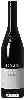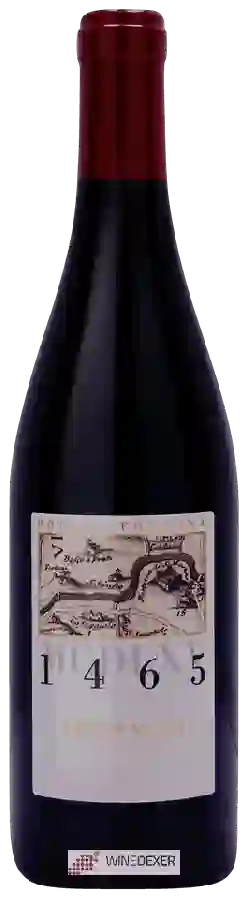
Winery FortunaMCDLXV 1465 Pinot Nero
 Red wine


In the mouth this red wine is a powerful with a nice freshness.
This wine generally goes well with poultry, beef or veal.
Taste structure of the MCDLXV 1465 Pinot Nero from the Winery Fortuna
Light | Bold | |
Smooth | Tannic | |
Dry | Sweet | |
Soft | Acidic |
In the mouth the MCDLXV 1465 Pinot Nero of Winery Fortuna in the region of Tuscany is a powerful with a nice freshness.
Wine flavors and olphactive analysis



On the nose the MCDLXV 1465 Pinot Nero of Winery Fortuna in the region of Tuscany often reveals types of flavors of non oak, earth or oak and sometimes also flavors of red fruit, black fruit or dried fruit.
Food and wine pairings with MCDLXV 1465 Pinot Nero
Pairings that work perfectly with MCDLXV 1465 Pinot Nero



Original food and wine pairings with MCDLXV 1465 Pinot Nero


The MCDLXV 1465 Pinot Nero of Winery Fortuna matches generally quite well with dishes of beef, lamb or veal such as recipes of wild boar with honey, rack of lamb with herbs or home-made coq au vin.
Details and technical informations about Winery Fortuna's MCDLXV 1465 Pinot Nero.
Discover the grape variety: Petit Bouschet
Crossbreeding carried out in 1829 by Louis Bouschet de Bernard (father of Henri Bouschet, also known for his numerous varieties) between the aramon and the teinturier. It was practically multiplied all over the world. Today, it is an extinct grape variety and can only be found in a few private or public collections and conservatories.
Last vintages of this wine

The best vintages of MCDLXV 1465 Pinot Nero from Winery Fortuna are 2007, 2011, 2010, 2009 and 0.
Informations about the Winery Fortuna
The Winery Fortuna is one of of the world's greatest estates. It offers 8 wines for sale in the of Tuscany to come and discover on site or to buy online.

The wine region of Tuscany
Tuscany is one of the most famous and prolific wine regions in Europe. It is best known for its Dry red wines made from Sangiovese grapes, which dominate production. These include Chianti, Brunello di Montalcino and Vino Nobile di Montepulciano. The region's Vin Santo is also highly prized, as are its passito dessert wines, though these are produced in comparatively tiny quantities.
The word of the wine: Phylloxera
Aphid that came from America and ravaged European vineyards at the end of the 19th century. It lives on the roots of the vine, from which it pumps the sap. The only vines capable of resisting it had to be imported from the United States, and then grafted onto their root system the wood of traditional French grape varieties. Today, grafted vines are always planted.