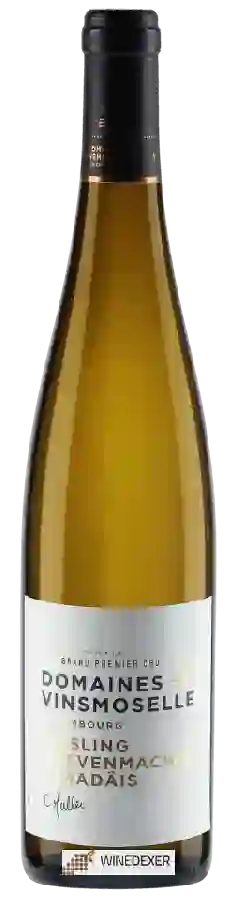
Domaines VinsmoselleGrevenmacher Paradäis Riesling Grand Premier Cru
 White wine



This wine generally goes well with pork, vegetarian or poultry.
Wine flavors and olphactive analysis

On the nose the Grevenmacher Paradäis Riesling Grand Premier Cru of Domaines Vinsmoselle in the region of Moselle often reveals types of flavors of earth, tree fruit or citrus fruit.
Food and wine pairings with Grevenmacher Paradäis Riesling Grand Premier Cru
Pairings that work perfectly with Grevenmacher Paradäis Riesling Grand Premier Cru



Original food and wine pairings with Grevenmacher Paradäis Riesling Grand Premier Cru



The Grevenmacher Paradäis Riesling Grand Premier Cru of Domaines Vinsmoselle matches generally quite well with dishes of pork, rich fish (salmon, tuna etc) or spicy food such as recipes of boeuf en daube, skate with vinegar and capers or chicken wrap.
Details and technical informations about Domaines Vinsmoselle's Grevenmacher Paradäis Riesling Grand Premier Cru.
Discover the grape variety: Riesling
White Riesling is a grape variety that originated in France (Alsace). It produces a variety of grape specially used for the elaboration of wine. It is rare to find this grape to eat on our tables. This variety of grape is characterized by small bunches, and small grapes. White Riesling can be found in many vineyards: Alsace, Loire Valley, Languedoc & Roussillon, Lorraine, Provence & Corsica, Rhone Valley, Savoie & Bugey, Beaujolais, South West.
Last vintages of this wine
The best vintages of Grevenmacher Paradäis Riesling Grand Premier Cru from Domaines Vinsmoselle are 2015, 2016, 0, 2018 and 2014.
Informations about the Domaines Vinsmoselle
The Domaines Vinsmoselle is one of of the world's great estates. It offers 177 wines for sale in the of Moselle to come and discover on site or to buy online.

The wine region of Moselle
Moselle is an appellation covering white, red and rosé wines from an area in the administrative department of Moselle in Northeastern France. The Vineyard">Vineyard zone covers land on both sides of the Mosel River (known locally as the Moselle), before it flows north to form the heart of Germany's famed Mosel wine region. Moselle wines are most often light, Aromatic whites with crisp Acidity. They are made predominantly from the Auxerrois Blanc and Müller-Thurgau grape varieties.
The word of the wine: Vaccaresis
Black grape variety, one of the 13 of Châteauneuf-du-Pape, which can be used in a blend in this appellation and other neighbouring AOCs (Côtes-du-Rhône, Gigondas...). It produces a floral, elegant and fresh wine, which balances the warmth of the Grenache. It is rare.