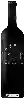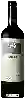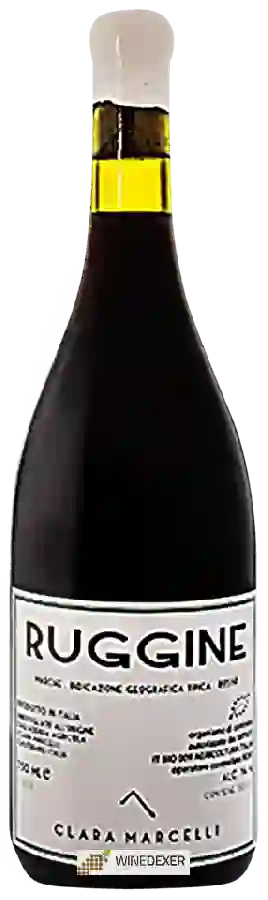
Winery Clara MarcelliRuggine
 Red wine


In the mouth this red wine is a powerful with a nice balance between acidity and tannins.
This wine generally goes well with poultry, beef or veal.
Taste structure of the Ruggine from the Winery Clara Marcelli
Light | Bold | |
Smooth | Tannic | |
Dry | Sweet | |
Soft | Acidic |
In the mouth the Ruggine of Winery Clara Marcelli in the region of Marche is a powerful with a nice balance between acidity and tannins.
Food and wine pairings with Ruggine
Pairings that work perfectly with Ruggine



Original food and wine pairings with Ruggine

The Ruggine of Winery Clara Marcelli matches generally quite well with dishes of beef, pasta or veal such as recipes of mexican beef tacos, chinese bowl or veal blanquette burger.
Details and technical informations about Winery Clara Marcelli's Ruggine.
Discover the grape variety: Schuyler
A complex interspecific cross between zinfandel and ontario (winchelle x diamond) obtained in 1932 by Wellington Richard. and Oberle G.D. at Cornell University in Geneva (United States). It can also be found in Canada, almost unknown in France. We noted that the boskoop glory resembles somewhat the Schuyler even if the origins, each time put forward, are quite different, to be followed!
Last vintages of this wine
The best vintages of Ruggine from Winery Clara Marcelli are 2012, 2011, 0
Informations about the Winery Clara Marcelli
The Winery Clara Marcelli is one of of the world's greatest estates. It offers 7 wines for sale in the of Marche to come and discover on site or to buy online.

The wine region of Marche
Marche (or Le Marche; pronounced Mar-kay) is a region in eastern CentralItaly. It is most associated with white wines made from Trebbiano and Verdicchio grapes. Marche occupies a roughly triangular area. Its longer sides are formed by the Apennine Mountains to the west and the Adriatic Sea to the east.
The word of the wine: Liqueur wine
Unfermented must with added brandy, also called liqueur wine: Pineau des Charentes, Floc de Gascogne, Macvin du Jura, Ratafia, Cartagène du Languedoc.