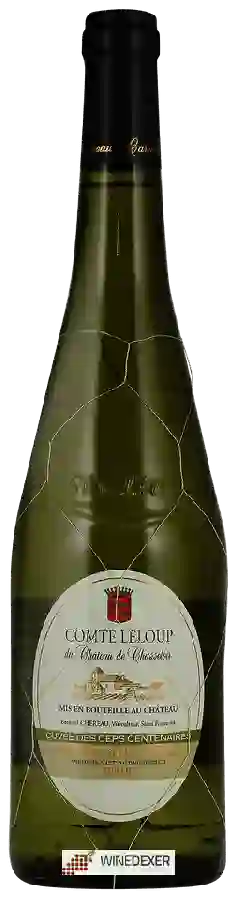
Winery Chéreau-CarréComte Leloup du Château de Chasseloir Cuvée des Ceps Centenaires
 White wine



In the mouth this white wine is a with a nice freshness.
This wine generally goes well with appetizers and snacks, lean fish or shellfish.
The Comte Leloup du Château de Chasseloir Cuvée des Ceps Centenaires of the Winery Chéreau-Carré is in the top 10 of wines of Muscadet-Sevre et Maine.

Taste structure of the Comte Leloup du Château de Chasseloir Cuvée des Ceps Centenaires from the Winery Chéreau-Carré
Light | Bold | |
Dry | Sweet | |
Soft | Acidic |
In the mouth the Comte Leloup du Château de Chasseloir Cuvée des Ceps Centenaires of Winery Chéreau-Carré in the region of Loire Valley is a with a nice freshness.
Wine flavors and olphactive analysis




On the nose the Comte Leloup du Château de Chasseloir Cuvée des Ceps Centenaires of Winery Chéreau-Carré in the region of Loire Valley often reveals types of flavors of pineapple, cream or grapefruit and sometimes also flavors of tropical, citrus or smoke.
Food and wine pairings with Comte Leloup du Château de Chasseloir Cuvée des Ceps Centenaires
Pairings that work perfectly with Comte Leloup du Château de Chasseloir Cuvée des Ceps Centenaires



Original food and wine pairings with Comte Leloup du Château de Chasseloir Cuvée des Ceps Centenaires

The Comte Leloup du Château de Chasseloir Cuvée des Ceps Centenaires of Winery Chéreau-Carré matches generally quite well with dishes of shellfish, appetizers and snacks or lean fish such as recipes of shrimp in coconut milk curry, emulsion of foie gras with pata negra or sole fillets with butter.
Details and technical informations about Winery Chéreau-Carré's Comte Leloup du Château de Chasseloir Cuvée des Ceps Centenaires.
Discover the grape variety: Chambourcin
Richly coloured and fruity reds with a purple colour and supple tannins, on aromas of black cherry, blackberry, blackcurrant, spices and herbal notes. Round palate, fresh finish, best drunk young. A disease-resistant hybrid, it produces organic and sustainable reds in the Loire Valley (IGP Atlantique, IGP Val de Loire), the United States (Pennsylvania, Missouri, Virginia) and Australia (New South Wales). French hybrid created in 1963 by Joannès Seyve.
Last vintages of this wine
The best vintages of Comte Leloup du Château de Chasseloir Cuvée des Ceps Centenaires from Winery Chéreau-Carré are 2004, 2014, 2010, 2015 and 2013.
Informations about the Winery Chéreau-Carré
The Winery Chéreau-Carré is one of of the world's greatest estates. It offers 43 wines for sale in the of Muscadet-Sevre et Maine to come and discover on site or to buy online.

The wine region of Muscadet-Sevre et Maine
The wine region of Muscadet-Sevre et Maine is located in the region of Muscadet of Muscadet of France. Wineries and vineyards like the Domaine de l'Ecu or the Domaine de Bellevue produce mainly wines white and red. The most planted grape varieties in the region of Muscadet-Sevre et Maine are Melon, Muscadelle and Folle blanche, they are then used in wines in blends or as a single variety. On the nose of Muscadet-Sevre et Maine often reveals types of flavors of cream, asparagus or baked apple and sometimes also flavors of honeydew melon, hay or citrus zest.
The wine region of Loire Valley
Kingdom of lively, dry whites and fine sparklers. Mineral, taut Sauvignon Blanc (Sancerre, Pouilly-Fumé) with citrus and gunflint notes. Multiform Chenin Blanc (Vouvray, Savennières, Layon): straight dry, floral off-dry or noble sweet honey-quince. Saline, iodised Muscadet (Melon B.
The word of the wine: Maturing (champagne)
After riddling, the bottles are stored on "point", upside down, with the neck of one bottle in the bottom of the other. The duration of this maturation is very important: in contact with the dead yeasts, the wine takes on subtle aromas and gains in roundness and fatness. A brut without year must remain at least 15 months in the cellar after bottling, a vintage 36 months.