The Château de Rolland of Bordeaux
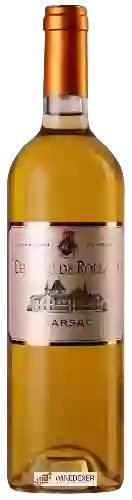
The Château de Rolland is one of the best wineries to follow in Bordeaux.. It offers 15 wines for sale in of Bordeaux to come and discover on site or to buy online.
Looking for the best Château de Rolland wines in Bordeaux among all the wines in the region? Check out our tops of the best red, white or effervescent Château de Rolland wines. Also find some food and wine pairings that may be suitable with the wines from this area. Learn more about the region and the Château de Rolland wines with technical and enological descriptions.
How Château de Rolland wines pair with each other generally quite well with dishes of fruity desserts or blue cheese such as recipes of apple pie or blue cheese and walnut quiche.
On the nose the sweet wine of Château de Rolland. often reveals types of flavors of apricot, non oak or earth and sometimes also flavors of tree fruit, apples or peach. In the mouth the sweet wine of Château de Rolland. is a powerful with a good balance between acidity and sweetness.
Bordeaux, in southwestern France, is one of the most famous, prestigious and prolific wine regions in the world. The majority of Bordeaux wines (nearly 90% of the production Volume) are the Dry, medium and Full-bodied red Bordeaux blends for which it is famous. The finest (and most expensive) are the wines of the great châteaux of Haut-Médoc and the right bank appellations of Saint-Émilion and Pomerol. The former focuses (at the highest level) on Cabernet Sauvignon, the latter on Merlot.
The legendary reds are complemented by high-quality white wines made from Semillon and Sauvignon Blanc. These range from dry whites that challenge the best of Burgundy (Pessac-Léognan is particularly renowned) to the Sweet, botrytised nectars of Sauternes. Although Bordeaux is most famous for its wines produced in specific districts or communes, many of its wines fall under other, broader appellations. These include AOC Bordeaux, Bordeaux Supérieur and Crémant de Bordeaux.
The Bordeaux Red appellation represents more than a third of the total production. The official Bordeaux wine region extends 130 kilometres inland from the Atlantic coast. 111,000 hectares of vineyards were registered in 2018, a figure that has remained largely constant over the previous decade. However, the number of winegrowers has consolidated; in 2018 there were around 6,000, compared to 9,000 a decade earlier.
How Château de Rolland wines pair with each other generally quite well with dishes of pork, vegetarian or poultry such as recipes of simmered pork cheeks with cream sauce and dijon mustard, mushroom, bacon and gruyere quiche or scandinavian beef balls.
Originally from Bordeaux, Sauvignon, or Sauvignon Blanc, is reputed to be one of the best French grape varieties for white wine. It is a white grape variety, not to be confused with Sauvignon Gris and its pale yellow color, or with Cabernet Sauvignon which produces red wines. Particularly famous thanks to Sancerre, Sauvignon Blanc is cultivated as far as New Zealand, where it produces great wines whose reputation is well established.
How Château de Rolland wines pair with each other generally quite well with dishes of beef, lamb or game (deer, venison) such as recipes of spanish stew (cocido), lamb breast with onions and tomato sauce or provençal tart with rabbit.
In the mouth the red wine of Château de Rolland. is a powerful with a nice balance between acidity and tannins.
See savagnin.
How Château de Rolland wines pair with each other generally quite well with dishes such as recipes .
Petit Verdot noir is a grape variety that originated in France (southwest). It produces a variety of grape specially used for wine making. It is rare to find this grape to eat on our tables. This variety of grape is characterized by small bunches and small grapes. Petit Verdot noir can be found in several vineyards: South-West, Languedoc & Roussillon, Cognac, Bordeaux, Rhone valley, Provence & Corsica, Loire valley, Savoie & Bugey, Beaujolais, Armagnac.
How Château de Rolland wines pair with each other generally quite well with dishes of beef or game (deer, venison) such as recipes of thai beef skewers or rabbit and mushroom gibelotte.
The process by which grape juice becomes wine, thanks to the action of yeasts that transform sugar into alcohol.
Planning a wine route in the of Bordeaux? Here are the wineries to visit and the winemakers to meet during your trip in search of wines similar to Château de Rolland.
Carménère is a grape variety of Bordeaux origin. It is the result of a cross between Cabernet Franc and Gros Cabernet. In France, it occupies only about ten hectares, but it is also grown in Chile, Peru, the Andes, California, Italy and Argentina. The leaves of the carmenere are shiny and revolute. Its berries are round and medium-sized. Carménère is susceptible to grey rot, especially in wet autumn. It can also be exposed to the risk of climatic coulure, which is why it is important to grow it on poor soil and in warm areas. Carménère is associated with an average second ripening period. This variety has only one approved clone, 1059. It can be vinified with Cabernet Sauvignon and Merlot. It produces a rich, highly coloured wine, which acquires character when combined with other grape varieties.