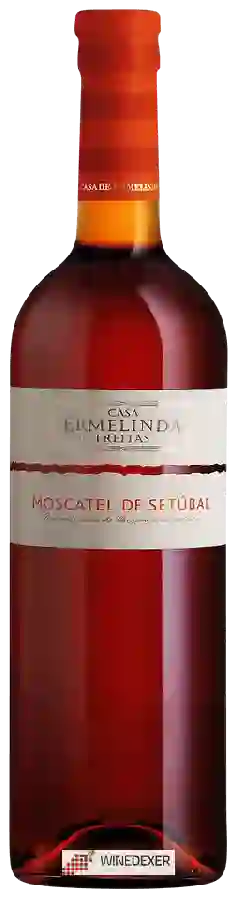
Winery Casa Ermelinda FreitasMoscatel de Setúbal
 Natural sweet wine



In the mouth this natural sweet wine is a powerful mainly marked by the residual sugar.
This wine generally goes well with blue cheese and sweet desserts.
Taste structure of the Moscatel de Setúbal from the Winery Casa Ermelinda Freitas
Light | Bold | |
Dry | Sweet | |
Soft | Acidic |
In the mouth the Moscatel de Setúbal of Winery Casa Ermelinda Freitas in the region of Península de Setúbal is a powerful mainly marked by the residual sugar.
Wine flavors and olphactive analysis






On the nose the Moscatel de Setúbal of Winery Casa Ermelinda Freitas in the region of Península de Setúbal often reveals types of flavors of citrus, leather or apricot and sometimes also flavors of caramel, raisin or prune.
Food and wine pairings with Moscatel de Setúbal
Pairings that work perfectly with Moscatel de Setúbal


Original food and wine pairings with Moscatel de Setúbal
The Moscatel de Setúbal of Winery Casa Ermelinda Freitas matches generally quite well with dishes of sweet desserts or blue cheese such as recipes of express cherry clafoutis or penne and pea gratin.
Details and technical informations about Winery Casa Ermelinda Freitas's Moscatel de Setúbal.
Discover the grape variety: Camaralet de Lasseube
The camaralet of Lasseube has its origins in the Pyrenees, in Bearn. It can be called gentil aromatique, petit camarau or moustardet. Its bunches are of medium size but its berries are small. The berries turn golden yellow when they reach maturity. This grape variety has two approved clones since 1998: 1023 and 1024. It occupies a little less than one hectare in France and is often vinified with other grape varieties such as lauzet and gros manseng. Camaralet de Lasseube is matured about twenty days after Chasselas. Its more or less compact and winged bunches are not affected by grey rot until after maturity. Its female flowers often expose this grape variety to significant risks of coulure, which makes it possible to obtain an alcoholic wine that is full-bodied but fine. Depending on the type, the aromas of the camaralet de Lasseube may recall fennel, pepper or cinnamon.
Last vintages of this wine
The best vintages of Moscatel de Setúbal from Winery Casa Ermelinda Freitas are 2011, 2005, 2017, 2013 and 2007.
Informations about the Winery Casa Ermelinda Freitas
The Winery Casa Ermelinda Freitas is one of of the world's great estates. It offers 106 wines for sale in the of Setúbal to come and discover on site or to buy online.

The wine region of Setúbal
The wine region of Setúbal is located in the region of Península de Setúbal of Portugal. Wineries and vineyards like the Domaine José Maria da Fonseca or the Domaine Horácio Simões produce mainly wines red, natural sweet and white. The most planted grape varieties in the region of Setúbal are Touriga nacional, Fernao Pires and Cabernet-Sauvignon, they are then used in wines in blends or as a single variety. On the nose of Setúbal often reveals types of flavors of orange, coffee or toasty and sometimes also flavors of clove, pear or lemon.
The wine region of Península de Setúbal
Setúbal Peninsula (also known as Península de Setúbal) is the Portuguese wine region immediately southeast of Lisbon, across the Tejo estuary. The Terroir in the area ranges from sandy coastal plains to the craggy, limestone-rich Serra Arribida hills. The area is known for its Dry red wines made from Castelão, and for its fortified wines and Sweet Moscatel de Setúbal. The wines produced here are made under three titles: two DOCs, Palmela and Setúbal, and one IGP.
The word of the wine: Barrel
Unit of measure for the transport and marketing of bulk wines, corresponding to 4 barrels of 225 l, i.e. 900 l.