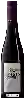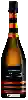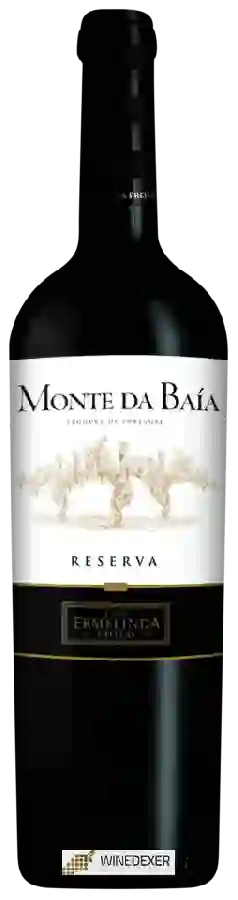
Winery Casa Ermelinda FreitasMonte Da Baia Reserva
 Red wine



This wine is a blend of 3 varietals which are the Tinta Barroca, the Touriga franca and the Touriga nacional.
In the mouth this red wine is a powerful with a lot of tannins present in the mouth.
This wine generally goes well with poultry, beef or veal.
Taste structure of the Monte Da Baia Reserva from the Winery Casa Ermelinda Freitas
Light | Bold | |
Smooth | Tannic | |
Dry | Sweet | |
Soft | Acidic |
In the mouth the Monte Da Baia Reserva of Winery Casa Ermelinda Freitas in the region of Península de Setúbal is a powerful with a lot of tannins present in the mouth.
Wine flavors and olphactive analysis


On the nose the Monte Da Baia Reserva of Winery Casa Ermelinda Freitas in the region of Península de Setúbal often reveals types of flavors of non oak, oak or spices and sometimes also flavors of red fruit, black fruit.
Food and wine pairings with Monte Da Baia Reserva
Pairings that work perfectly with Monte Da Baia Reserva



Original food and wine pairings with Monte Da Baia Reserva

The Monte Da Baia Reserva of Winery Casa Ermelinda Freitas matches generally quite well with dishes of beef, pasta or veal such as recipes of beer goulash, pastasciutta (corsica) or oven-baked veal cutlets.
Details and technical informations about Winery Casa Ermelinda Freitas's Monte Da Baia Reserva.
Discover the grape variety: Tinta Barroca
Most certainly Portuguese, more precisely in the Douro region where it is very present. It can be found in Spain, Portugal, South Africa, ... almost unknown in France, registered in the Official Catalogue of A2 list varieties.
Last vintages of this wine
The best vintages of Monte Da Baia Reserva from Winery Casa Ermelinda Freitas are 2014, 2013, 0, 2017
Informations about the Winery Casa Ermelinda Freitas
The Winery Casa Ermelinda Freitas is one of of the world's great estates. It offers 106 wines for sale in the of Península de Setúbal to come and discover on site or to buy online.

The wine region of Península de Setúbal
Setúbal Peninsula (also known as Península de Setúbal) is the Portuguese wine region immediately southeast of Lisbon, across the Tejo estuary. The Terroir in the area ranges from sandy coastal plains to the craggy, limestone-rich Serra Arribida hills. The area is known for its Dry red wines made from Castelão, and for its fortified wines and Sweet Moscatel de Setúbal. The wines produced here are made under three titles: two DOCs, Palmela and Setúbal, and one IGP.
The word of the wine: AOC
Appellation d'origine contrôlée. The most prestigious category of French wines created in the 1930s on the basis of quality criteria defined by a geographical delimitation, a chosen grape variety and precise production rules.