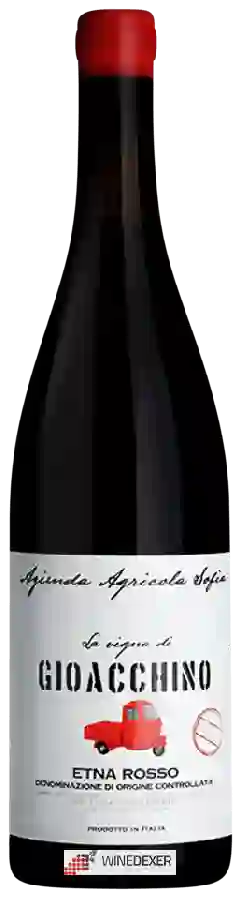
Winery Azienda Agricola SofiaLa Vigna di Gioacchino Etna Rosso
 Red wine


In the mouth this red wine is a powerful with a nice balance between acidity and tannins.
This wine generally goes well with beef, lamb or pasta.
Taste structure of the La Vigna di Gioacchino Etna Rosso from the Winery Azienda Agricola Sofia
Light | Bold | |
Smooth | Tannic | |
Dry | Sweet | |
Soft | Acidic |
In the mouth the La Vigna di Gioacchino Etna Rosso of Winery Azienda Agricola Sofia in the region of Sicily is a powerful with a nice balance between acidity and tannins.
Wine flavors and olphactive analysis



On the nose the La Vigna di Gioacchino Etna Rosso of Winery Azienda Agricola Sofia in the region of Sicily often reveals types of flavors of cherry, minerality or strawberries and sometimes also flavors of earth, oak or red fruit.
Food and wine pairings with La Vigna di Gioacchino Etna Rosso
Pairings that work perfectly with La Vigna di Gioacchino Etna Rosso



Original food and wine pairings with La Vigna di Gioacchino Etna Rosso
The La Vigna di Gioacchino Etna Rosso of Winery Azienda Agricola Sofia matches generally quite well with dishes of beef, pasta or lamb such as recipes of navarin of the sea da gigi, pasta with walnuts and treviso red salad or pastillas with lamb and apricots.
Details and technical informations about Winery Azienda Agricola Sofia's La Vigna di Gioacchino Etna Rosso.
Discover the grape variety: Riesling italien
We do not know exactly where this grape variety comes from. It can be found in Austria, Romania, northern Italy, Croatia, Serbia, Hungary, Bulgaria, the Czech Republic, Slovakia, Russia, etc. It is practically unknown in France. In Spain, Borba is said to be identical to the Italian Riesling.
Last vintages of this wine
The best vintages of La Vigna di Gioacchino Etna Rosso from Winery Azienda Agricola Sofia are 2017, 2018
Informations about the Winery Azienda Agricola Sofia
The Winery Azienda Agricola Sofia is one of of the world's greatest estates. It offers 3 wines for sale in the of Etna to come and discover on site or to buy online.

The wine region of Etna
The wine region of Etna is located in the region of Sicile of Italy. Wineries and vineyards like the Domaine Tenuta delle Terre Nere or the Domaine Gambino Vini produce mainly wines red, white and pink. The most planted grape varieties in the region of Etna are Nerello mascalese, Carricante and Nero d'Avola, they are then used in wines in blends or as a single variety. On the nose of Etna often reveals types of flavors of cherry, lime or new leather and sometimes also flavors of maraschino cherry, slate or crushed gravel.
The wine region of Sicily
Sicily is the Southernmost region of Italy, and the largest island in the Mediterranean Sea. For over 2500 years, Sicily (Sicilia in Italian) has been an important centre of Mediterranean viticulture, although the reputation and style of its wines have changed considerably over time. The island was once best known for its Sweet muscatels (see Pantelleria), and later for its fortified Marsala. Today, many of its best-known wines are Dry table wines produced under the regional designation IGT Terre Siciliane, or Sicilia DOC (see below).
The word of the wine: Leaflet
Small barrel with a capacity of 112 to 136 litres depending on the region.