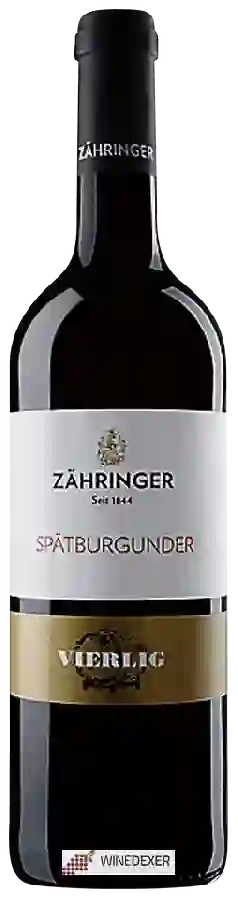
Winery ZähringerSpätburgunder Vierlig
 Red wine



In the mouth this red wine is a with a nice freshness.
This wine generally goes well with poultry, beef or veal.

Taste structure of the Spätburgunder Vierlig from the Winery Zähringer
Light | Bold | |
Smooth | Tannic | |
Dry | Sweet | |
Soft | Acidic |
In the mouth the Spätburgunder Vierlig of Winery Zähringer in the region of Baden is a with a nice freshness.
Food and wine pairings with Spätburgunder Vierlig
Pairings that work perfectly with Spätburgunder Vierlig



Original food and wine pairings with Spätburgunder Vierlig

The Spätburgunder Vierlig of Winery Zähringer matches generally quite well with dishes of beef, veal or game (deer, venison) such as recipes of beef stew provencal style, capon stuffed with morels or duck breast in the oven.
Details and technical informations about Winery Zähringer's Spätburgunder Vierlig.
Discover the grape variety: Rouge du Pays
Structured and elegant reds with a deep ruby robe, firm yet melted tannins and a dense palate with fine acidity, showing signature aromas of red fruits (morello cherry, raspberry), spices, pepper and Alpine mineral notes. Fine Valaisan ageing potential. Star of the great Valaisan reds on the sun-drenched slopes of the Swiss Rhône, a typical expression of Alpine terroir. Valaisan synonym for Cornalin, native black grape from Valais, identical to Cornalin from the Aosta Valley.
Last vintages of this wine
The best vintages of Spätburgunder Vierlig from Winery Zähringer are 2015, 0
Informations about the Winery Zähringer
The Winery Zähringer is one of of the world's great estates. It offers 76 wines for sale in the of Baden to come and discover on site or to buy online.

The wine region of Baden
German capital of Pinot Noir (Spätburgunder): silky, fine reds with notes of red fruits, cherry, undergrowth and sweet spices, melted tannins. Round Grauburgunder (Pinot Gris), lively Weissburgunder, supple Müller-Thurgau, mineral Riesling. Germany's 3rd region (15,000 ha) in Baden-Württemberg facing Alsace, one of the country's warmest climates, volcanic soils at the Kaiserstuhl. Cradle of modern great German reds, elegant and fine.
The word of the wine: Noble rot
A fungus called botrytis cinerea that develops during the over-ripening phase, an ally of great sweet white wines, when it concentrates the juice of the berries. It requires the humidity of morning fogs and beautiful sunny days, gives musts very rich in sugar and brings to the wines the famous taste of "roasted".